
Arewa Girls
We were girls once. The girls you once saw hawking on the streets of Arewa—selling awara, wainan rogo, dan wake…
The online magazine of new writing from around the globe
25 September 2026
The KrisFlyer miles of a dead person cannot be redeemed.
The woman on the hotline said it as if she was underlining it in red ink with a ruler. She spoke with that irritatingly patient customer-service chirp. I imagined her out at Changi Business Park, manicured fingers parked on the keyboard and a mug of 3-in-1 Nescafe gone cold on her desk. Behind her, a dusty Seiko wall clock ticking down the minutes until her shift finally ends.
‘Once Singapore Airlines receives the death certificate,’ she said, ‘the account will be closed. The remaining miles will be forfeited.’
‘Thank you,’ I said. I had learnt early in life that saying thank you and sorry quickly always made life easier.
I sat at my mother’s desk. The air conditioner kept the room at 22 degrees, the temperature she trusted through midnight forex trades and marathon Chinese drama.
Glossy binders stood at attention on the shelf: Tax, Property, Shares, Investments, Divorce. The labels were aligned to a millimetre. A wireless mouse rested beside a lined notepad, where she wrote in block letters. Lemongrass cleaner and a trace of rose hand cream remained in the room.
Marcus, my younger brother, kept his air conditioner at 18. Mine stayed at 26. Mum’s was at 22. Marcus was cold efficiency. I was the glowing radiance of a fireplace. Mum was the thermostat, regulating his eccentricity and my intensity. If Marcus went silent or I cried too easily, she would do the same thing: put her hand on our shoulders. She had the magic to turn our unuttered words into sentences neither of us could form. The climate of mediation in our family seemed to be at its peak at 22.
Grandma stayed at 24. She would have set it to 26 to save electricity, but the traditional Chinese herbal soups she took for longevity always kept her body temperature at an almost-boil. Frugal even at 90, she always counted coins. ‘That is how rich people get rich,’ she liked to say, meaning not the ones who spend but the ones who notice every cent. ‘They do not spend on nonsense like jeans with holes everywhere.’ She always mocked my ‘ventilated clothes.’
Mum rolled her eyes, and I laughed. Grandma always meant what she said.
‘Are you going to do something with the miles or not?’ Marcus was standing in the doorway, a towel around his neck. He had on a T-shirt from a start-up that had already died. He wore it like a prize.
‘I am doing something.’ I pointed at the laptop. The airline site glowed the official blue that makes numbers seem wiser than they are.
‘You look like you are watching a slow boil.’ His glance flicked around the room, inventorying. ‘The sooner we close things, the sooner we move on.’
‘Close what things?’ My mouth felt full of dust.
‘Close her bank accounts. Sell the flat.’
‘What? I’m still not ready, and well, we haven’t even discussed this. But can you please…she just died. I need more time.’
‘Eventually we will have to.’ He wistfully rubbed the towel across his neck.
He made a step into the room, then stopped. I really hated how there was always this invisible line he drew between us.
I clicked ‘Reset Password’ on the airline’s site. A verification code flashed on Mum’s old phone.
My eyes moved between her phone and the desktop screen as I entered the numbers. The screen refreshed.
Seventy-six thousand, two hundred and forty miles.
Two economy return tickets to Hong Kong.
Miles counted how far you could go. Tears started, uninvited. I willed myself to swallow them back in, along with my pride. ‘Two tickets,’ I said.
‘Good,’ Marcus said. ‘Sell them.’
‘You cannot sell love. Two tickets for both of us, you idiot.’ It slipped out and sounded embarrassing.
‘Not me. You use them.’ He shrugged. ‘Just don’t waste them.’
He left to shower a second time. He was always newly clean, hinoki on his towel, hair wet morning and night. If success was rated based on personal hygiene, he would come up tops. His room, however, looked like a small apocalypse. Receipts under the bed, cables in knots, but it was the unopened letters from telcos and banks that really irked me. He wanted money so he could have his own life. And possibly to never need anyone.
The last time Mum and I went to Hong Kong, she was so happy to have me plan our itinerary. A café from In the Mood for Love that photographed better than it tasted. Goose at Yat Lok, skin crisp as sugar glass. Freshly baked lao po bing that warmed in my hand, the winter melon sweet with salt. And then of course, two lunches and two dinners so that I could max out that list of must-eats from a good friend.
‘I love to watch you eat,’ she said. ‘Appetite is proof of life.’
Marcus had not come. ‘Travel tires me,’ he had said.
After the funeral, I decided to concentrate on logistics to replace the pain. Once the airline received the death certificate, Mum’s account would close. I pictured a clerk pressing Delete, erasing her departures with a single click. That could not be her ending. If bureaucracy could tidy her away, then anyone could be tidied away. No.
During her chemo, I became almost paranoid. Alarms for pills, then scrambling to key timestamps into the same Excel sheet that had logs for nausea. Wiping antibacterial wet wipes copiously on remote controls until the button labels blurred. I also had to make sure I was top-notch pure. Abruptly leaving any social gathering with anyone carrying mild sniffles and inwardly marking them selfish and inconsiderate. Making sure I always spend 10 minutes alone in the car after I’ve parked it to recalibrate before going back up to the flat.
‘You are very systematic,’ the oncologist said once. He meant it as a compliment, but I somehow felt my body tense up.
When Mum’s hair began to fall out, she would continue to brush what remained to grasp whatever sense of normality and routine she could hold on to. One day, a whole clump came away in the brush. I collected the strands and sealed them in a plastic bag.
After she died, every sound turned into a sad break-up song. The fridge clicked like a metronome. Once, the washing machine’s end-chime made me cry, which was ridiculous.
Marcus handled the estate with shortcuts and charm. ‘When can we sell the flat?’ he said, fingers scrolling his phone mid-sentence.
‘You are rushing.’
‘You are stalling.’
‘We cannot hold property forever,’ he said at last.
I wanted to tell him we cannot hold people forever either but gulped down the retort. My silences came with sound effects.
That night I poured lemon soda from the Sodastream I had bought to replace Mum’s Perrier. She had switched to sparkling during chemo. Bubbles made hospital taste less like hospital. The fizz rose. From the corridor, Marcus laughed at a video. It startled me. I stood in the kitchen and listened to him laugh.
The phone rang once at 11:12 p.m. Grandma’s helper. One ring meant nothing urgent. My heart rate disagreed.
I opened the CCTV app. Four squares woke: bed, hallway, living room, kitchen. Grandma stood in a pink nightdress. The three safes were open. Money lay in careful stacks, blue and beige. She counted aloud, ‘One hundred. Two hundred. Three.’ The helper stood worried in the doorway.
I hit the rewind and replay button. Open safe. Unfold notes from batches of 10, counted, counted again. The helper moved her mouth, and Grandma waved her away. The gesture belonged to Mum, rearranging pillboxes that did not need rearranging. Grandma’s hands quivered but kept up the progress she had set her mind on.
The helper closed the curtains. Grandma lay down. Careful, careful, she would mutter. That is how people keep what they have.
I locked the phone.
‘Keep things under control,’ Mum had said. She had never said what.
*
Two months after the funeral, the time came to take the flight booked using Mum’s miles. I booked because the woman on the hotline had said what would happen once the airline received the certificate. The account would close. The miles would disappear. Deletion by strangers, neat and irreversible.
A mix of sanitiser and orchids hit my nose as I stepped into Changi Airport. My partner Kai met me at the gate, tired from work. He took my bag without asking. We had stayed together out of kindness that had evolved into the routine of senior couples.
Marcus should have been here. I had asked again if he wanted to go.
‘No,’ he said.
‘Why not? Mum would have liked both of us to enjoy her miles.’
‘Work.’
That was Marcus.
We boarded. The cabin lights softened. I opened the in-flight magazine. The plane lifted. Metal trembled. Mum’s miles, converted into velocity before disappearing from this world too.
‘Window?’ Kai offered.
I shook my head. Politeness is the softest wall.
Hong Kong received us with heavy humidity. We followed the itinerary from Mum’s last trip. Roast goose at Yat Lok, the skin lacquered and shining, the taste numbed by absence. At a bakery, I bought lao po bing, her favourite. The pastry flaked into my bare palm, the winter melon filling warm and fragrant. I tested a piece immediately, to see if my memory still worked.
‘Too sweet,’ I said, though sweetness was not the problem.
Mongkok still had the In the Mood for Love café. This time bastardised by couples posing under red curtains for the ‘gram. I ordered milk tea. Grief loves routine the way film sets love continuity.
‘Do you want to talk about her?’ Kai asked.
‘I am already doing that,’ I said and sipped too soon. The heat moved across my tongue.
At the hotel, condensation drew lines down the glass. Our reflections glowed side by side. He put my hand in his. I did not move closer or farther away. We put the Do Not Disturb sign on the door and went to sleep.
On the flight home, the uneven base of my plastic cup kept trembling with the turbulence. I watched an animation where everyone forgave everyone else. And then stared mindlessly for a long time at the map, which showed a small plane inching toward Singapore. The miles were being spent in real time.
Marcus was in the living room when I returned. Boxes everywhere, a suitcase wide open.
‘I am moving out,’ he said.
‘Because of me?’
‘Because someone has to.’
I looked at the box labels. Electronics. Spare parts. He had written them in the same blunt marker Mum used for binders.
‘You could stay,’ I said. ‘We could practise being alive together.’
He shrugged. ‘I will still be alive somewhere else.’
‘Where?’
‘With friends.’
Later, relatives would say I drove him away. I stopped correcting them.
That night I slept in Mum’s bed. The air conditioner stayed at 22. I watched a cartoon. I cried through the closing song.
A week later the helper called. One ring. Silence. Of course, I rushed over to Grandma’s.
The corridor had this weird mixed smell of boiled herbs and mop water. The helper opened the gate. Grandma sat beside the window in a freshly pressed nightdress, hair brushed high, as usual.
‘You knew to come by?’ she said.
‘I thought I should.’
‘Drink tea.’
The porcelain pot was the same one she used for Mum’s anti-cancer herbal concoctions. The tea was light and too hot. Exactly right for her. She shifted the saucer until it lined up with the edge of the table. My throat stiffened.
‘You are tired,’ she said, studying my face like it was a price tag.
‘I just got back.’
‘You went to Hong Kong.’
I nodded.
‘Your mum liked that place.’
‘She came along with me too,’ I said. ‘In a way.’
‘Good,’ Grandma said.
She pointed at the air conditioner remote. ‘Twenty-four. Higher would save me a lot of money, but then my orchids faint.’
We sat together in a familiar silence. The helper watered those orchids. Grandma stared at the red roses her manicurist had drawn on each of her nails with intense concentration.
‘Your brother called,’ she said.
‘About what?’
‘He asked if I needed him to buy anything.’
‘Do you?’
‘I need children who eat,’ she said and pushed a plate across the table: two lao po bing, the cheap brand. ‘Take. For later.’
‘Always eat something,’ she added. She looked at me directly, the way only older people can because old people have trump cards. ‘You must start to spend.’
‘Spend what?’
‘Your life,’ she said. ‘Otherwise, what for?’
Back at the flat, I placed the pastries on Mum’s desk beside the binders. I poured sparkling water. The fizz rose and continued dancing. I logged into the airline account to check what I already knew.
Zero miles. The absence looked clean.
In Marcus’s room, a neat rectangle of dust marked where the bed had been. I did not message him. Let him sleep at 18 degrees wherever he wants.
Nights broke into intervals I had not set. I woke, listened, slept again. The air conditioner repeated 22 like a reassuring sentence. Morning assembled in degrees.
The death certificate arrived by registered mail in a heavy envelope. The stamp showed a bird in flight. I uploaded the document to email to the airline address that the hotline woman had recited from memory. The progress bar filled gradually until the whole thing was green.
Weeks arranged themselves. I worked. I replied to relatives in polite phrases. I cleaned the air conditioner filters once a month. I powered on appliances in case they felt neglected. I watched Disney before bed as a form of therapy.
At 2:03 a.m. one Friday, Marcus texted, ‘How are you?’
I wrote: I am fine.
He replied: Got a job. He did not say where. I pictured socks under a new bed, a shower running twice a day. His kind of peace.
A month later, an email popped up from the airline. It confirmed the account closure and thanked my mother for her loyalty. It invited me to consider new routes. I closed it and stared at the air-con remote control. I raised the temperature by one degree, to 23.
The next morning, I lowered it back to 22. Disloyalty should be gradual.
I began clearing drawers in Mum’s room. Appliance manuals for retired machines. Receipts arranged by month, ink fading to ghost. A notebook of travel dates and flight numbers. In the margin beside ‘Hong Kong,’ she had written ‘nice to watch you eat’ and drawn a small square that might be a window or a seat.
I found the plastic bag of hair I had kept. I held the bag up to the window. The hair caught light and then did not. I decided to place it in the bin gently.
At dusk, I walked to the void deck. A boy ran past with his shirt untucked. A man smoked and looked like he had just decided something. A cat paced along a wall. The lights came on in a pattern that denied explanation.
Back upstairs, the flat took me in. The desk as I had left it. The binders waiting patiently. A cartoon stopped at a chorus. I pressed play. A raccoon in a hat solved a minor problem with song.
In Marcus’s absence, the flat changed shape. Silence extended into the corridor. I did the monthly maintenance Mum had taught me. Run the washing machine empty. Descale the kettle. Read the water meter. Record the number. Compare to last month and feel useful.
I started to answer people’s messages with the truth. Not the heavy truth, the small truth. ‘How are you?’ someone would ask.
‘I can set the aircon to 22 without crying,’ I would say. Or ‘I have stopped disinfecting the remote control every evening.’ Or ‘I watched something without singing in it.’
Sometimes I told polite lies. ‘I am fine,’ I would type and then stand at the window and count the buses.
Kai came over on a Sunday with a bag of groceries. ‘I got the expensive broccolini,’ Kai said, lifting it like an offering. ‘In case we need to feel accomplished.’
‘We can congratulate ourselves for boiling water later,’ I said. We cooked too much and ate without speaking. When Kai left, I could feel the door’s vacuum seal detaching.
At 1:11 a.m., the airline sent an automated reminder to review my recent flight. I tapped five stars because the plane had not fallen out of the sky. I closed the survey, went to the kitchen and drank water so cold it scorched my throat.
A few days later, I picked up the air conditioner remote and pressed the up arrow. Twenty-three. I listened to the compressor adjust. The sound reminded me of someone clearing their throat to speak and then changing their mind. I went to bed and did not fall asleep. I got up and lowered it back to 22. I fell asleep immediately and dreamed about counting coins inside a freezer. The coins stuck to my fingers.
It took me another week to try 23 again. The second attempt lasted. The world did not end. Grandma still counted. Marcus still texted at odd hours.
I took the notebook of travel dates and copied her neat, square numbers onto a fresh page. In the margin beside Hong Kong, I wrote, Mum watched me eat. Then I drew a small square that looked a bit like a seat. I drew a second one beside it.
At the end of the month, the local town council sent a notice about energy saving. The flyer advised an optimal household temperature of 24 to conserve energy. I taped it to the fridge and laughed out loud, a sound that surprised the flat.
That evening, I took the remote and pressed three times.
Twenty-six.
The air moved, softly. I sat at Mum’s desk, the binders within reach, the lao po bing wrapper crunched in my hand, the email closed, the miles gone forever too. Condensation gathered on my glass without asking my permission. The room remained itself.
In the morning, I returned it to 22. Then I raised it to 24. I was experimenting. I laughed at my foolishness, realising that I had attempted to keep a person from becoming data.
On a Tuesday, I messaged Marcus: Do you want roast goose next month? My treat.
He typed, Where.
I typed, Where I went with Mum on that last holiday.
He typed, Maybe.
Maybe was two syllables and definitely warmer than no.
I booked two tickets anyway. With money, not miles. I pictured a counter agent looking at both of us, just as we were, carrying our chosen degrees into another city. I saw us eating quietly, then not quietly, then arguing about the bill, then me paying because that is how rich people get rich.
I switched off the TV and snuggled under the covers. I set the aircon to 24 and placed the remote face down. I had let the miles between us rearrange themselves into something countable: for the first time in forever, I allowed it.
We were girls once. The girls you once saw hawking on the streets of Arewa—selling awara, wainan rogo, dan wake…
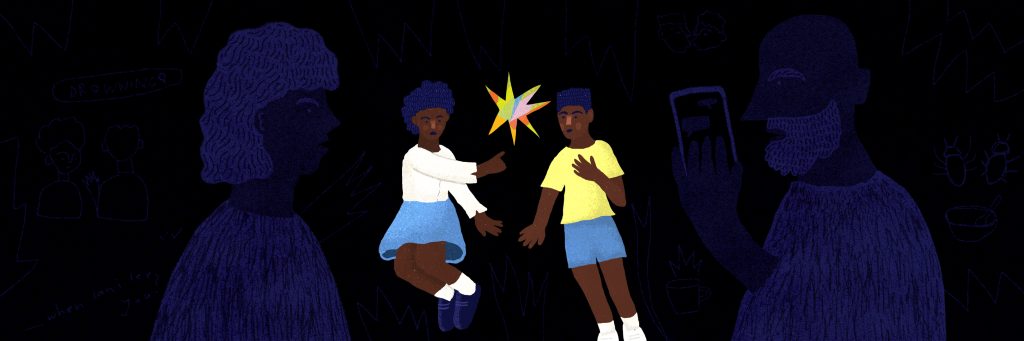
The new game Oyin and I invented is called Shock-Me-I-Shock-You. We play it whenever our parents aren't around. Often, Daddy…
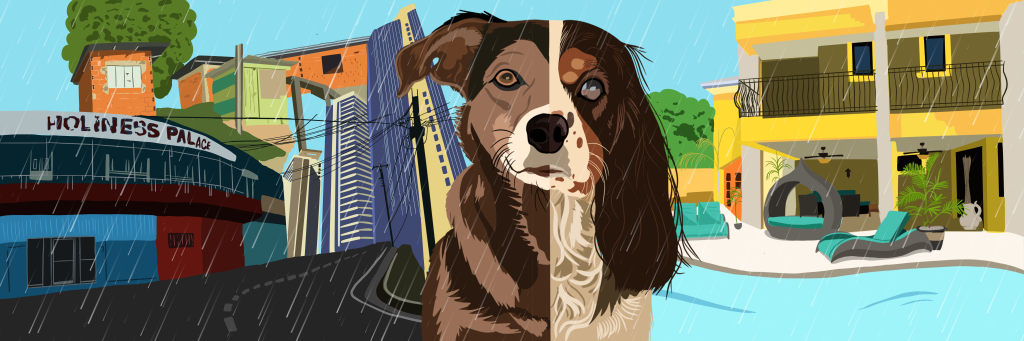
The sun feel uneasy, shining too hard—like it know something coming. I glance up. Corbeaux wheel above the market, wings…
Sign up to receive new pieces of writing as soon as they are published as well as information on competitions, creative grants and more.