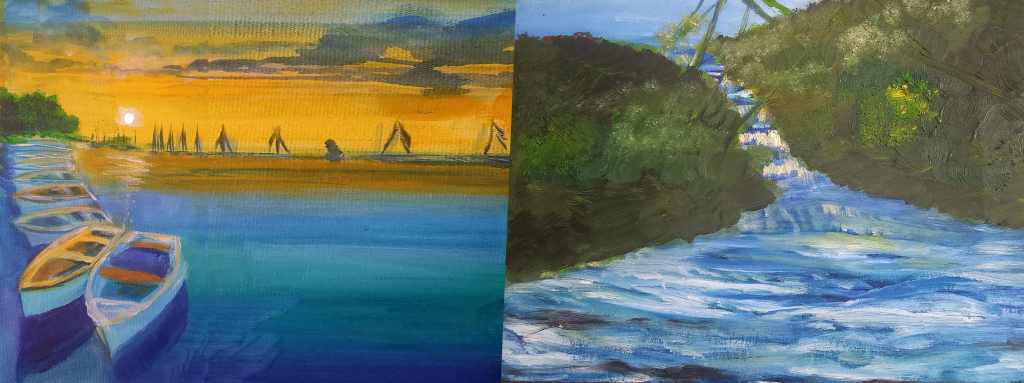
River Mouth
Evening used to come soft in Icacos, slipping through coconut trees and over cracked fishing pirogues on the shore. Lately,…
The online magazine of new writing from around the globe
14 October 2026
It all started in the monsoon of 1950—or 51? It was a golden day, soon to turn grey. I had seen the men first. I was sitting at the highest fork of the mango tree in our uthaan, where I’d climbed up an hour earlier to hide from Borochachi, having shattered one of the delicate cups from her Bilet-bought china set—the cups that trembled even when you looked at them too hard. The tree was a man, we used to say, because it never bore any fruit but had a thousand leaves which rippled, when the occasional wind came their way, to remind us of our fathers and chachas loitering around the house like time personified, in their faded addi-cotton panjabis, doing nothing. The men walking carefully by the banks of Boro Pukur and coming towards our house wore richly embroidered panjabis that sparkled like fish-scales in the sun and had servants trailing behind every pair of them, holding umbrellas over their heads. They were not like the men of our house. They glimmered and glittered, like light rippling off a crisp new note; our men were sovereigns, with a grounded heaviness about them. These men—they were strangers: never before had I ever seen them in the village, and that was itself a rupture in the way that things had been. We rarely ever had guests we did not know, and it was quite improbable that there’d be such exciting, mysterious guests coming today and I’d be unaware of it! Cups forgotten, I glided down the mango tree in a rush, scratching the insides of my arms and tearing my worn-out soft cotton shari in three places, to announce the news. But already, the house had settled into a strange, expectant hum. No one was speaking, not quite, but it was quite apparent that something was happening. Chotochachi was setting up plates of snacks; Amma was making tea; Asma buji was smoothing Paira apa’s hair into a sheen, and Borochachi was searching for her gold and emerald brooch in the folds of hurried silence—each of them moving through the late afternoon as if summoned. It was the height of strange.
I went to my mother and snuggled close to her like I used to do as a child, ‘Amma, there are some men coming this way—never seen them before,’ and then as an afterthought, I added, ‘They looked rich.’
‘They’re coming to see Paira.’ Amma smiled at me.
‘What for?’ I asked, because this was simply not the norm.
‘For marriage, silly.’ Amma shook her head. ‘Now run along to your father and tell him to set up the chairs in the uthaan.’ She looked up at Borochachi. ‘Bhabi, we aren’t hosting them in the house, right?’
Borochachi shook her head, irate: ‘I was not up for even this—coming to see a girl of this house—have you ever heard of such a thing?’
‘Plain shame, that’s what.’
‘You’ll get back at him if you get married, na Paira bu?’ Asma buji giggled, making Paira apa blush and cover her face with hands.
Ma prodded me sharply, ‘Quick, go—’
See, never before had a girl of Suruj Maulvi Bari been inspected before marriage. It was taken for granted that they’d be everything a family could wish for in a wife, if not more—their only flaw being lice. And well, that’s not really a flaw, is it? It’s more like a built-in masseuse for the scalp. I tell you, that’s why we have thick hair in the first place.
Anyway, everyone considered it a disgrace for the house, but our family was losing wealth—slowly, softly—like steam rising off tea in winter. The library business in Kolkata had started to fail, with 1947 and what-not, and the family that had sent the proposal was rich enough to bedeck Paira apa in gold from head to toe.
Small sacrifices.
We all looked from behind the curtains my father had put up, as the to-be-groom’s father asked Paira apa her name. She answered. After a moment of silence, he blessed her with 10 gold coins.
Ten days later, the groomsmen came with horses and an elephant, and Paira apa was carried off in a bejeweled palki. We all cried. Our tears trailed off to Jamuna, and, that night, I dreamt of the twins for the first time. They came together, hand in hand, and stood in front of me. The sister braided my hair while the brother told me tales that made me sob into his embrace. I woke up in cold sweat—I thought I had urinated, but it was just blood.
After Paira apa, it became quite the habit for grooms’ families to barge into our home, looking for suitable daughters of a khandan bongsho. The chairs would be placed beneath the mango tree, and curtains would be drawn for us to peek from behind—always the same curtain, always the same rustling hush. Asma buji, Salma buji, Raima apa: they were all married off, one by one, like names crossed off a quiet list, and suddenly, I was the eldest daughter at home. I had never thought of it until Amma told me to wear the new sari one day, ‘Wear the one your father bought yesterday. And come here, let me do your hair today.’
I wore a yellow sari with golden zardozi work at the border. It was lovely. I felt like the sun. But when the ‘chacha’, the father of the prospective groom, asked me if I knew Surah Fatiha, and everyone looked at me, curious to hear my voice, the sun lost its splendour.
‘Aūdhu billāhi min ash-shayṭāni r-rajīm, bismillah hir Rahman ur Raheem,’ I started in the name of Allah, warding off Shaitan peeking from behind the clusters of mango leaves above me. My voice trembled, ‘Alhamdu lillahi rabbil alameen—Ar, ar Rahmaneer—’ and I crumbled, breaking down like those flimsy cookies Dada brought from Kolkata every time he went to check on his business. Marie? Maria? I couldn’t recall their name. All I could remember, as I looked down at my alta-drawn feet trying to hide themselves inside the hem of the new sari, was how Asma buji used to laugh and laugh when Salma buji’s cookie fell right into her cup of tea and dissolved into mush. I used to eat mine with guava jam spread over it: my teeth all shook and tingled as I bit down the sweet, sweet delicacy; Paira apa used to pull my hair every time she saw me stealing from Amma’s jam jar, calling me a—what was it that she called me? My eyes watered up—how can I not remember? I recite the lines at least forty times each day during namaaz, ‘Ar Rahmaneer Rahim—Maaliki Yawmid-Deen—Iyyakana—’ I wanted to hide—to be anywhere but here, under the scrutiny of strangers who toyed with my memory and had the audacity to laugh. Oh, but fear creeped in—what if they do not like me? What if they—it was clear to me that I was not rich, nor was I fair like Asma buji and Paira apa. I did not have, as they did, a Bilayeti education. I could not sing—oh no no no—what if they do not like me? Big drops of tears dropped on my lap. I looked up at the man who had asked me if I knew Surah Fatiha and nodded,my voice trembling in embarrassment. ‘I know Surah Fatiha by heart’.
The man had kindness spilling out of his eyes, and the stream twinkled as he chuckled, ‘Of course you do. I know you do,’ and then he looked at my father to say,‘We like her, Moulvi sa’ab.’
There was a clamour of ‘Alhamdulillah.’ Baba told me to offer my salam, ask for blessings, and I did—difficult as it was, with the veil of my sari over my head—squat down and touch his feet. I noted how fair his feet were—the toenails cut and clean. My dust-specked ones shied away from one another in shame.
He put a hand on my head and said, ‘Will you accept this bura as your son, ma? Will you look after this old man?’ I nodded, smiling through the salty tears. He laughed and gave me a little red packet of sovereigns.
A week later, it was my turn to leave home. It was not a procession of grandeur, however. No palanquin swayed beneath a velvet canopy; no elephants trumpeted beneath silks, and no horses bore witness. My in-laws were practical people, and so, they arrived in two motorcars coughing smoke, as if they had swallowed a curse. They took me away in them, wrapped in a green sari with dead stars sparkling in sequin. My sister had wept at the blinding ugliness of the fabric, which shimmered like a dying fever dream every time I moved. For three hours, the engines growled through the winter dusk, until the one that bore me stuttered, groaned and surrendered in the middle of a road that knew no village. December bit through my bones and I shivered.
I peered through the half-open window, seeking the kind old man who had once pressed the little red bag into my palms. But he was not there. Nor was the man I had been married to, whose voice I had never heard and whose face I could not recall with clarity. Instead, a young man materialised from the dark, his breath steaming in the cold, and said,
‘Bhabi, we’re trying to fix the car or find a van; just sit tight for a few more minutes, hmmm?’
Shyness grew like moss from the car seats, creeping up my spine and blooming into briars that caught in my throat, making a nest of thorns around every word I tried to speak. I longed to ask, ‘How much further?’ I had never been without my parents before.
‘Bhabi, you alright?’ the man asked.
His voice was so calm and his manners so gentle, I fell into a torpor of ease. ‘How long until we reach your house?’
‘My house? It’s your house, too, now, isn’t it?’ He laughed, a laugh that did not keep me out of the laughter but folded me in so that I too smiled. He nodded, ‘About one and a half kilo left—forty minutes once we get moving’.
I bit my tongue—how could I tell him I needed to piss? Surely, I could not. If I had my amma around, sure. But here, in the midst of people I had never seen before, surely, I could not just go around asking where I could piss in the middle of the forest. The rest is unclear. I don’t remember the faces or what became of the broken car or how we finally got home. What I do remember is this: waking at Fazr, the azan curling through the walls like silver smoke, and finding myself in a bed softer than any I’ve ever lain upon. Beside me slept a man, snoring lightly. His lips were slightly parted, and he slept with his head on one of his hands. He was the most beautiful man I had ever seen. I stared at him, expectant and afraid—his fair skin scared me. Not the pallor of the memsahib who came to our home with her Bible, leechlike and bloodless. He was fair like clouds at dawn—like the sun was about to burst from within him. I looked at him and then at my sapota-skin—soft, swollen, mottled with patches of pigment—and fear thickened like tar in my chest, restricting my airways—I could not breathe. Clutching at my throat, I edged away from him.
Outside, the world hummed awake, its pulse slipping through the cracks of the room. Oju—I thought, tearing myself away from the image of the man—where is the tube-well?
‘Bou? There you are.’ An older woman hurried over to me: ‘Come with me.’ I knew she was his mother, right away—this was a house of houris, and I was the lone earthen thing. She pressed a kharata-broom into my hands, told me to sweep the uthaan before I began to cook. Of course, she would have done it herself, but the broom blisters her palms, and the cinder leaves her nails charred. I could not tell her I had never cooked. I could not tell her I never swept uthaans. I could not let her think my mother—my sweet, loving, kind mother—taught me nothing. I could not let her think that I, sapota-skinned and dowry-less, did not even know how to cook for 35 people. And so, silence became my second skin as I worked and worked and worked because I could not render myself useless. For if I did, the silence would grow teeth, and it would eat me alive.
Night carried me back to my husband. He had his father’s eyes: I swam in their kindness. When he looked at the blisters in my palm and asked, ‘What happened?’ I only shook my head. He was agitated. I understood he had as little idea as I did as to what happens when newlywed husbands and wives are left alone in their chambers. He touched my hand, tracing the blisters, and though the sting rose sharp, I did not pull away. I liked him. He did not do what Asha buji said her husband did—did not press his mouth against mine until I could not breathe, did not mark my neck with his teeth, did not bruise the humble swell of my breasts. Instead, he gathered me into him. My ear pressed against his chest; I could hear the ocean beating there, waves collapsing and rising again. His fingers combed through my hair as if searching for prayers. And I sobbed, quivering and small, the room tilting around us, the walls of our worlds cradling us.
I do not know what I had expected, but my husband was nothing I had thought husbands were like. He was soft-spoken and quiet about his ways, except when he laughed. He liked to shake the house with his laughter. And everything was fine, really, with my working from 6am to 8pm and living off scraps and bits and pieces because my lovely husband did not earn a penny; everything was grand. My husband, a dumb man with damning pride, would never stoop to toil in an office like the angrezi babus.‘I have land, don’t I? Am I an Anglo that I must work?’
His damning pride—thick as a banyan root, winding through the house, choking its rooms. The world was turning, but he stood with his back to it.
‘It’s not your land—it’s your father’s. You have to prove yourself to him—don’t you see?’
But he did not see. He did not see that because he did not earn and because his brother did, we received one kilo of rice a month while his brother received four kilos despite being unmarried. He did not see that I cooked seven different meals, three times a day, for 35 insatiable mouths; that I swept the uthaan until my palms blistered; that I washed the household linen so that his idleness would not stain us. He did not see that my body was swelling with fatigue, with hunger, with his child. And I did not know how to make him see. It was his sister, Maleka apa, who finally pointed it out.
‘Don’t you understand, Moinuddin? Your wife is pregnant. Take care of her—she looks ready to drop any moment.’
But it was Maleka apa’s clothes that made the tallest pile because she changed bedsheets every other day. She could not bear to eat rice for breakfast like everyone else, and I had to make rotis for her every morning. And so, her words pricked at my ears, but as my husband looked at me—embarrassed that he had not noticed—and I looked down, a tide of shame and joy rolled through me, twisting together, impossible to separate. I felt the pulse of life inside me, secret and fierce, and a quiet pride that would not be denied hummed beneath the layers of my fear and delight.
Days stretched themselves thin, each hour unending, and yet I never had time. This incomprehensible streaming of time left me muddled, my mind clouded with anticipation and nervousness. I could only be proud in the seclusion of our bedroom, before my husband, who smiled guiltily each time his eyes lingered on my swelling belly. In front of others, I stood numb, fragile, my strength fraying thread by thread. My mother-in-law loved me, yes—but she loved me mostly for the tables I dusted, the paddy I chaffed, the rice I coaxed into steam, the clothes I scoured—all of which allowed her a mid-afternoon nap. And she was not glad. This startled me, for I remembered my own mother shaping golap-pitha, pressing Kashmiri lobongo into its folds, when my brother’s wife first began to carry. But I was surprised only for a moment. The two houses were different—strangers to one another—and I knew this better than most. Still, I longed to visit my home: my own home, my home with my mother, my father who demanded cha every half hour, my borochachi who scolded anyone and everyone only to break into her thunderous laughter the very next moment. I knew my mother would care for me. Oh, how I longed to be cared for. What a luxury it was to have someone braid your hair into a kolabeni. One afternoon, staring at my frizzed, unruly hair, I cried wells of tears. My lovely, lovely hair had withered into nothing for lack of tending. I knew how to oil it, but when would I? And who would comb it? And oil was expensive, and my husband earned not a paisa. My husband looked at me quizzically, and I only shook my head; how could I make him understand the only source of fragile pride I carried secretly in this household had been destroyed? My husband went back to reading the newspaper; he knew by then that I cried when the sun rose, and I cried when it set, and he could not do anything to stop the tears from flowing. Ours was silence and ours were nights. So, I waited until it was dark and everyone was asleep before telling him that I wanted to visit my mother. He kissed the mole on my chin. ‘I’ll see what I can do,’ he said.
‘I hired 20 extra hands for the Nayabari construction, and now you tell me that your wife is not going to be here?’ my mother-in-law shrieked at her son the next day, ‘Didn’t occur to consult me at first, did it? Who’ll cook now? Who’ll do the dishes? Will I hire help for that? Who’ll pay them? You?’
I looked over my shoulder at them—his face downcast and his hands fidgeting. He said something I did not quite catch, to which his mother shouted, ‘Yes, your wife decides to go on a vacation, and your younger brother has to pay for that?’ Of course not. Shrinking in shame, I looked away. I went about my day, not raising my eyes and fighting the languor of heat and heaviness. When everyone had had their lunch, though, I could not hold the exhaustion in anymore. Hunger crawled out of me to claw at my face, but what would I eat? There was not enough rice for the labourers, and there were no leftover rotis from the morning. I walked to the papaya tree, checking for its ripe fruits, but there were none. Too tired to stand, I sank into its shade, leaning against the thin green trunk of the tree. Black ants streamed in a line beside me, climbing upward. Asha buji would sprinkle powdered turmeric over leaves of brinjal and papaya trees to drive ants away. The green leaves flecked with gold beckoned to me, sunlight winking and laughing through the gaps between leaves.
And then I saw them. A few feet away, hand in hand, mouths sealed tight as trapdoors to a cabinet that has not been opened in years. They looked at me, hesitant and curious. Their fair feet caked with mud and their eyes shining with an air of mischief I knew only too well. I beckoned to them with my half-closed eyes, and it was enough of an invitation. They ran to me. It was only a short distance, of course, but they ran for hours, letting go of each other’s hands in a contest to reach me first. The girl, with her agile legs, won, shortly followed by the boy who had a quieter way about him. He stopped before me and looked at the girl in dismay. ‘You broke the oath.’ Forgive me, Hemanta Mukherjee, I thought to myself, for this is the loveliest voice I have ever heard. I pulled him closer to me, and the girl tugged at the hem of my shari, demanding my attention. I wrapped my other hand around her.
Her eyes, bright with mischief, were my father’s eyes. ‘The oath was to reach home.’ He looked away from her and hid his face in my bosom. Never before had I felt the urgency to protect anyone so fiercely before. I did not ask for their names because I knew already they had not yet been given any. I held them tightly, and my head spun with disbelief coupled with hunger.
The girl kissed my neck before whispering, ‘I wanted to come earlier, in the night, but he slowed me down.’ The boy shook his head, not deigning to speak. The girl, her cheeks flushed from the running, went on, ‘We do not have long, and we have to be on time… he’s not as forgiving as you.’
‘Stay,’ I whispered. ‘Stay and I’ll look after you. No one will hurt you.’
‘We will stay, when it’s time, and we won’t ever go away,’ she said and bit her lip. ‘I was climbing up the titi-jaam tree today, but this stupid little boy just had to fall on his face just when I was getting to the top, you know, where all the good and ripe ones are—’ Her eyes danced as she spoke, her hands moving up and down as if weaving the story out of thin air, ‘—and so I had to come down, didn’t I? Because who else would look after him, if not me?’
He mumbled, ‘Next time, don’t bother. Pick your titi-jaams and leave me be.’
I laughed. It had been a long time since I had laughed. ‘You’re just like your father,’ I said, as I brushed his hair with my fingers.
The girl looked at me, eyes wide, waiting: ‘And who am I like?’
I looked at her scraped knee, her restless hands, the mole on her small, upturned nose, her lips on the verge of trembling, her eyes already full of stories she has not yet lived, and I knew. ‘You are all the people who taught me to love.’
I woke up to the azan—the melodious voice of Sharifuddin chacha seared me away from the warmth. It was the Waqt of Asr. I would blink, and it would be dark, and the prayer time would be over, but a languor had taken hold of me. Back home, we would all compete to complete the Asr prayers because Baba would start telling us stories right after finishing his namaaz. The short time between Asr and Maghrib, between day and night, would be filled with stories of Ibrahim (as) taking Ishmael for the Qurbani, of Naseeba in the Battle of Uhud, of Bibi Hajra scouring the mountainous desert in search of water for her son. Baba, his face aglow in the hurricane light, told us about Yunus Nabi repenting inside the belly of the whale. His abandonment forgiven, he was thrown out. Thereupon he immediately got down to his knees and prayed as the day ended. It was Asr. A time of transition. I rose up. I had to pray.
She (for it was a she; he must have lost the race to my arms again) came to me on a Friday evening. The men of the house had gone out to fish after Jumma prayer and lunch, and the women would be sprawled across their beds, caged by the sly clasp of bhaatghum, if I had not been giving birth. Pain had taken residence in me, as it had in my mother and in hers before her: ancient pain, familiar in ancestry yet new in its cruelty. I had not known that the back too could ache, that the heart could burn as though lit from within, that hips could splinter into a thousand small stars every time the body convulsed. ‘Quiet, bou, hush,’ they said. ‘The quieter you are, the more patient the child will be.’ So, I bit down on a soft cotton dupatta, tears sliding silently into my hair. I wanted Amma. If she had been here, I thought, the pain would surely have softened; the terror would have stilled; perhaps the world would have righted itself. But mothers do not simply arrive at their daughters’ in-laws’ homes. It is not the way of things. And besides—the cost. The cost, the cost, the cost. My father was coughing blood, I had learned from her long, uneven letter. They could not afford the train fare to Calcutta, let alone a doctor. Guilt gnawed at me. I could do nothing. As I lay on that bed, waiting, I thought only of my mother’s hands until I could no longer think. Then I remember tinkling laughter—people were waking up—the sound of quick footsteps and heavy buckets coming in. It was 5:30.
My father-in-law sang the azan into my daughter’s ear before coming up to me and saying, ‘I have glimpsed paradise, bou. Firdaus?’
Firdaus. Paradaiza. She was handed to me. My little speck of heaven. With her eyes barely open and her stubbed nose, she looked lovelier than any vision I had ever dreamed. I was looking for my husband, and he soon came in, a little crestfallen—there was no fish. I tried to rebuke him with my eyes, but only tears fell. But as his eyes found his daughter, I saw fishes swimming out of his mind. He stared at her, in wonder, and then looked at me as if to ask a question he did not quite know how to phrase.
Life was wonderful for seven days because seven days is the most you get in a busy household. There were no stitches left to dry, no medicines to heal from. The body, having performed its miracle of creation, was now ordered back into service: to sift paddy, to churn milk into ghee, to press caramelised coconut into pithas. It was Autumn—the air smelled of ripening grain and dying leaves. Firdaus was not getting milk. Strange concoctions—oils, herbs, dust, prayers—were handed to me, and I drank everything anyone said might help. But still, she cried. After nine nights of her thin, breaking wail, they brought a doctor. He peered at me from behind the curtain, and his voice cut through the air: ‘She needs rest and she needs food. Are you all blind?’ Doctor’s orders.
My mother-in-law’s nose flared, her voice thick with scorn. ‘As if we never had children, as if we never fed them. It’s the blood, I tell you. I told Khaansa’ab to find a better girl, from a family we know, but no, he liked her. For what?’
For the first time, her words did not sting. I looked at Firdaus, and she looked at me, and we lived a life that was just ours. Nothing permeated it. She had grown weaker, her thin limbs lighter than breath. Even the act of opening her eyes seemed to tire her. I rested; I ate. On the second day, milk overflowed from me, soaking through my blouses—too much abundance for a mouth too faint to drink it. I spoke to her through the hours, telling her stories—some I remembered; some I made up as I went. She listened, her eyes half-closed, as though sleep and death were one and the same gentle sea.
On the third night, she died. I held her close, telling her stories until Fazr pierced the air between us and my husband stirred awake. She was put into her grave by her father. Death was a masculine fest. I did not cry. Crying would only solidify the distance. On the fifth day, Rabeya apa came from next door. Her sister-in-law had given birth, and her milk had not yet come in. She asked, quite plainly, if I could share mine since I had so much and no one left to drink it. And I did. The milk was salty.
Evening used to come soft in Icacos, slipping through coconut trees and over cracked fishing pirogues on the shore. Lately,…
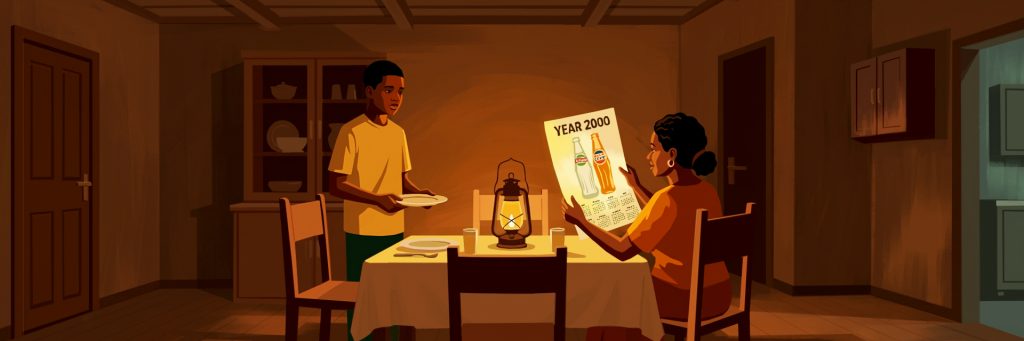
Akure, Nigeria, 1999 January: My new guardian was a performer of miracles. A pastor whose anointed touch could heal sicknesses.…
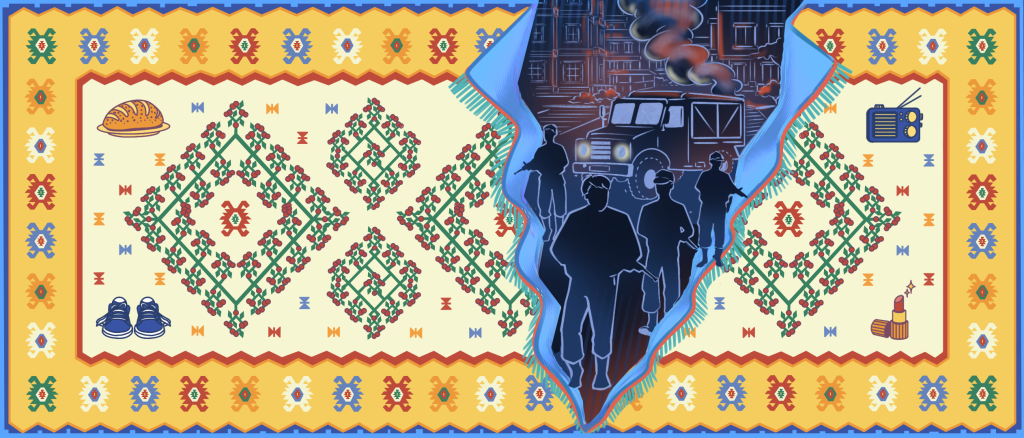
“There are no innocents; there are only those who have not yet suffered.” —Ivo Andrić, The Bridge on the Drina…
Sign up to receive new pieces of writing as soon as they are published as well as information on competitions, creative grants and more.