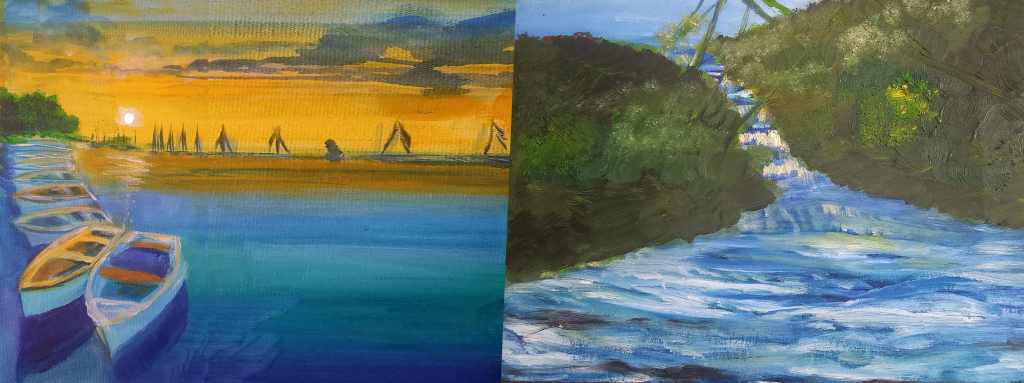
River Mouth
Evening used to come soft in Icacos, slipping through coconut trees and over cracked fishing pirogues on the shore. Lately,…
The online magazine of new writing from around the globe
14 October 2026
“There are no innocents; there are only those who have not yet suffered.”
—Ivo Andrić, The Bridge on the Drina
Blue Sneakers
I was the only girl in school with blue sneakers. Not sky blue like chalk, but deep blue, like the middle of the river when the sun leaned on it. They squeaked when I ran, which made the boys groan because you could hear me coming before the ball touched my foot. I didn’t care. They were mine. Mama said we couldn’t afford them, but Baba bought them anyway with his “railway money.” When Mama scolded, he only shrugged: A daughter must have wings.
I tested them every morning on the path behind our building, kicking stones, trying to make the dust rise the same way the footballers on TV kicked clouds of dust. The sneakers gave me more speed, or maybe I only imagined it. Still, I wore them even to the mosque once, and Amra whispered that God didn’t like squeaks on His carpets. I laughed, though I bent down and untied them quickly, hiding them under the bench with everyone staring. Shoes weren’t allowed inside anyway, but I liked to think Allah would forgive my little attempt to show off.
The river was already swollen that spring. It ran brown. Ana once said the river carried messages and if you listened, you’d hear it whisper.
That day, the water was so high we couldn’t cross the steppingstones. Emir cried because he wanted to go to the orchard on the other side to steal plums. He was only eight and thought every fruit in the world belonged to him. Aida hissed at him to be quiet.
I said, “If we wait for the river to calm, it’ll be autumn already,” and Ana laughed.
We were all waiting for summer to come properly, because then the ice cream cart would ring its bell down our street. I had decided that this summer, I’d eat strawberry every time, no matter what. Strawberry is a grown-up color, a kiss color.
In secret, I was practicing how to look older too, with Ana’s mother’s lipstick. Ana had shown me how to twist the tube until the red crown pushed up. Ana had shown me how to twist the tube until the red crown pushed up. We smeared it on and blew kisses at the cracked mirror in her hallway, choking on our giggles. Ana swore her mother would kill her if she found out.
Sometimes, when nobody watched, I paired the lipstick with one of Baba’s cigars. He kept them in a green tin box, tucked behind flour bags, and I stole one just to hold it between my teeth. I didn’t light it. I only pretended, puffing air until I coughed. But the mirror made me look dangerous. Like a singer in a sevdah song, the kind Mama listened to when she thought nobody was paying attention.
Afterwards, I’d scrub my lips raw with soap, because Mama always smelled things on me. A girl must not reek, she would say, wagging her finger. She never explained what reek meant, only that people carried their lives on their skin. That scared me, the idea of everyone sniffing out your secrets.
At school, nobody cared about secrets. They cared about whose father had brought sweets from Zagreb, whose uncle was working in Germany and sending jeans, who had gold hoops in their ears. Ana had hoops. Zlata had nothing, but she still walked like a queen, chin high, daring anyone to laugh at her patched dress. I envied her the most, because she didn’t need blue sneakers or lipstick.
The grown-ups whispered, as they always did. In the evenings, Baba sat by the radio, frowning, twisting the knob until voices crackled from Belgrade, Zagreb, sometimes even Vienna. Mama knitted, her needles clicking fast as if they wanted to argue too. I caught words here and there: tension, borders, refugees. Big words that floated above me like balloons, out of reach. When I asked, my older sister Aida rolled her eyes and said, ‘You wouldn’t understand.
But when I walked to school, the street still smelled of bread, and the kiosk still sold chocolate wafers, and the old man at the corner still played his accordion for coins. So, what could be wrong? The world kept turning, didn’t it?
That night, Ana brought her cassette player over, and we lay on my floor, heads close, listening to Crno-bijeli svijet. We didn’t know the lyrics properly, so we hummed until the chorus, when we shouted the words. Emir banged on the door, begging to be let in, and we threw pillows at him when he burst through. It was too hot to sleep anyway.
When Baba came to check, he found us tangled on the rug, lipstick smeared, sneakers tossed by the door. He stood for a moment, a shadow against the light, before shaking his head and saying, Girls, girls, the world is serious, and you are wasting it on nonsense.
But his voice wasn’t angry. It was tired.
I pressed my face into the rug to hide my grin, the wax taste still on my mouth, and thought: I have all the time in the world.
The Orchard
The orchard wasn’t ours, though we always said it was. Rows of pear, plum, and cherry leaned over the hill, heavy with fruit, their branches bending low as if waiting for us. No one guarded them except a rusted scarecrow with one arm missing. From spring to the last hot days of September, we plotted raids like soldiers drawing maps.
Ana was always first to scramble up, hoop earrings flashing like medals. Emir darted after her, quick as a squirrel, stuffing his pockets until they bulged. Mina hung back, muttering that if her mother found out, she’d lose more than supper. Aida climbed too, though she pretended it was only to keep her books from the dirt. Zlata came barefoot, patched dress fluttering, chin high when we teased her for taking the bruised fruit.
I was slowest because I liked to stop halfway, sneakers pressed against the bark, and look out over the valley. The river flashed below, brown and swollen. Sometimes I thought if I listened hard enough, I’d hear it telling me what was coming. But then Ana would call from above, daring us higher, and the spell would break.
We argued about which fruit was best. Ana swore the sour cherries gave you courage, popping them into her mouth one after another until her lips were stained red. Emir spat pits into the grass, aiming for Mina’s hair. She shrieked, and Aida scolded us for behaving like animals, which only made Emir dangle upside down, until she nearly dropped her books. Zlata never argued. She climbed, slow and steady, like she had made a pact with the tree: I won’t hurt you if you won’t hurt me. When she found a branch heavy with plums, she ate in silence, juice running down her chin, eyes closed like she was praying.
That summer, a new boy appeared. Dark hair, sharp eyes, older than us by a year or two. He carried a slingshot and could hit a pear dead center from the ground. Emir adored him instantly. Ana hated him for beating her at climbing. Aida said nothing, though I caught her staring. Zlata tilted her head and watched him as if she saw something the rest of us didn’t. When I asked his name, he only shrugged. Marko, he said finally, though I wasn’t sure if it was the truth.
We let him stay. He shared his pears, and that was enough.
In the orchard, the world was only this: sticky fingers, laughter tangled in the branches, the heavy breath of fruit above us. But beyond the hill, we noticed changes. Jeeps leaving dust on the road. Men in mismatched uniforms shouting in words we weren’t allowed to repeat. They hadn’t come to the orchard, not yet.
One afternoon, Emir tried to climb a thin young tree, and the branch snapped beneath him. He fell hard, the breath knocked out of his chest. For a moment, the orchard held its breath with us. Then Emir wheezed, laughed, and soon we were all rolling in the grass, laughter spilling from our ribs until the trees themselves seemed to shake with it.
Later, when the radio crackled at night and Mama’s needles clicked sharp and fast, I thought of that laughter. It rang as if we believed the orchard would always be ours. As if the world could never change.
Bread and Radio
Evening was the hour our house came alive. The day’s dust followed Baba in through the door, clinging to his boots, mixing with the smell of onions and oil that drifted from Mama’s kitchen. My little brother Armin banged a spoon against the table, chanting for bread, and Aida swatted him with her schoolbook without looking up.
Mama’s bread came out round and golden, the crust crackling when she cut it. She always saved the first slice for Baba, though he complained about how much flour cost now. Yesterday it was ten dinars, today fifteen. Soon we’ll be eating the crust of our shoes. His voice was rough, but he winked at me, and I laughed, even though I didn’t understand why flour kept changing.
The radio hummed in the corner, perched on the shelf between the family photos and Mama’s jar of dried lavender. It always hummed. Some nights it was music, tamburica strings sharp and quick, and Baba tapped his fingers alongside. Other nights, low voices spoke words that slowed Mama’s hands, words about tensions, checkpoints, cleansing.
I liked to sit with my notebook open, sketching faces, while the grown-ups talked. Sometimes I drew Mama’s hands, always moving; kneading, stirring, mending. Sometimes Baba’s shoulders, stooped but strong. Once, I drew Uncle Haris, though I smudged his nose too wide. That was before he stopped coming by. No one said why, only that he was away. Away was a strange word. It didn’t say if someone was safe or not.
We all ate fast, tearing bread, dipping it into stew until the bowls shone clean. Afterwards, Baba leaned back, cigarette glowing in his fingers, while Mama gathered plates with sharp clatters. Aida lectured me on schoolwork, though she hadn’t seen the doodles in my margins. Armin asked for another story about the orchard.
Then the radio crackled again, loud enough to hush us. A voice, distant but sharp, naming towns, naming roads. Baba’s cigarette froze halfway to his lips. Mama’s hand tightened on the plates. They shared a look across the table, the kind of look children weren’t supposed to notice.
I kept my head bent, shading the curls around a face in my notebook. But my ears burned with the sound of their silence. That night, when the lights clicked off, I lay awake listening to the radio’s faint hiss through the walls.
Sevdah Nights
It started with Baba, cigarette smoke curling as he adjusted the radio knob. Sometimes he found a football game, voices rising and falling with goals I never saw. Sometimes it was static, endless and gray. But when he found music, particularly slow, mournful songs carried by a woman’s voice, then Mama’s needles stilled, and the whole room shifted.
She pretended not to listen, eyes on her knitting, but I knew the songs were hers. The lyrics, always about lost loves, rivers, and wounds that never healed, seemed to bloom from the very walls.
I’d lie on the rug, sneakers kicked off, notebook open, and sketch the shadows the lamp threw across the ceiling. Armin snored on the couch. Aida whispered her school lessons to herself. But I was somewhere else, in the city, maybe, with glittering, big lights.
Sometimes Ana brought her cassette player, and we made our own concerts. She smuggled lipstick, and we painted our mouths red as cherries, stood on chairs with wooden spoons for microphones. Emir heckled from the doorway until we bribed him with the last piece of chocolate. We sang off-key, shouted the choruses, collapsed in giggles.
Once, Ana said, When the war is over, we’ll sing in Zagreb. Big stage, real lights.
I laughed. What war? There isn’t a war.
She only shrugged, twisting the cassette tape between her fingers.
That night, after she left, I washed the lipstick from my face, but the color lingered, staining.
The River’s Secrets
In summer, it gave us stones to skip, mud to smear on our arms, water cold enough to make us shriek when we dared each other in. In winter, it gave us beautiful thin ice we weren’t allowed to step on.
That spring, the water was swollen again, rushing harder than usual, carrying whole branches. We sat on the bank, tossing pebbles and arguing about whose throw could reach the middle. Ana claimed hers did, though her splashes barely dented the surface. Mina counted each stone and Zlata threw in silence, watching the ripples stretch.
It was then we heard the men.
At first, it was only voices, low and clipped, drifting through the reeds. Emir scrambled toward the sound, thinking it was fishermen with nets. But Ana hissed at him to stop, pulling him down beside us. The voices grew clearer, the words sharp and strange, heavy like rocks rolling in a barrel.
We crouched low, hidden by the tall grass, and peered through the stalks. Across the river, two soldiers stood on the bank.
“…cleansing,” one said.
The other spat into the water. “They’ll run before we get there. Cowards always do.”
I didn’t understand the word. Cleansing. I thought of soap, of Mama scrubbing the laundry in a basin, bubbles rising like clouds. I thought maybe they were talking about washing in the river itself.
But Ana stiffened beside me, her lips pressed tight. Aida shook her head as if to chase the words away.
A pebble slipped from Mina’s fingers and dropped into the river. The splash echoed too loud.
Both soldiers snapped their heads up. One lifted his rifle, scanning the reeds. We froze, hearts thudding. My sneakers squeaked when I shifted, and Mina elbowed me, eyes wide with panic.
For a breath, I thought they’d seen us.
But the men only muttered, shouldered their rifles, and moved upstream, their voices fading into the trees with reeds rattling behind them.
We exhaled, all at once. Emir giggled, thinking it was a game. Aida slapped his arm and whispered, “Idiot.” Ana didn’t laugh. She stood, brushing off her skirt, staring at the place where the men had been. Zlata touched the water with her bare toes, then pulled back as though it had turned to fire.
“What’s cleansing?” I asked finally.
No one answered.
Later, as we walked home, Emir chattered about plums waiting in the orchard. Ana stayed silent. She only glanced at the river once, then quickened her pace.
That night, when Baba tuned the radio, the word came again. Cleansing. Baba’s hand froze on the dial. Mama’s needles stopped mid-click.
I thought of the soldiers, of their boots sinking in the mud, of the way the river swallowed their spit.
The Soldiers Arrive
They came in the morning, when Mama’s bread was still rising and Baba had just left for the railway yard.
At first, I thought it was a parade. Boots thundered against the street. I pressed my face to the glass, expecting flags, drums, maybe even music like in the old festivals.
But there were no drums. Only men. Men in uniforms that didn’t match, walking in rows that weren’t straight, their rifles slung carelessly, like toys.
The air itself seemed to bend around them. Dogs barked, then whimpered quiet. Curtains twitched. The street that usually smelled of bread and onions now smelled of diesel and sweat.
A jeep followed, coughing smoke, its antenna bent like a broken arm. Children clung to their mothers’ skirts, watching from doorways. Some men waved politely, uncertain. The soldiers didn’t wave back.
One soldier stopped outside our building. He was young, maybe only a little older than Aida. His beard looked too new for his face, his eyes too old. He knocked his rifle against the door, once, twice, as if the wood itself should be afraid. Mama froze at the table, flour still on her hands. Armin started crying, his spoon clattering to the floor.
I ran to pick it up, and Mama whispered, Stay quiet.
When she opened the door, the young soldier pushed past without asking. He looked around the room as though he owned it, his boots leaving mud on the rug where Armin played. Another soldier followed, heavier, with a scar splitting his lip. He didn’t look at us, only at the shelves, the cupboards, and the corner where the radio sat.
Mama’s voice trembled but stayed clear. Can I help you?
The soldier with the scar smirked. Bread. Cigarettes. Where’s your husband?
At work, she said.
He walked to the radio, turned the dial until static screamed, then switched it off. Don’t listen too much. It makes people stupid.
The young one kept staring at me. At my sneakers. At my hands, still smudged from drawing in my notebook. I pressed the notebook against my chest until the paper bent.
Finally, the scarred one grabbed two loaves from the counter, stuffed them into his jacket, and laughed. Payment for protection.
They left without another word, boots thudding down the stairs.
Mama shut the door, leaned against it, her chest heaving. Armin sobbed louder. Aida hissed, Don’t cry, idiot. But her own eyes shone wet.
I laced my sneakers tighter, as if their blue could keep me safe.
Ashes in the Orchard
The orchard had always smelled of sweetness: of pears, plums, cherries sagging from their branches. But the morning the soldiers came up the hill, it smelled of smoke.
I smelled it before I saw it. A bitter tang that stuck in the throat, different from the woodfires in winter. This smoke was harsher, blacker, like it wanted to choke the trees themselves.
Ana and I had planned to meet there, like always. I carried my notebook under my arm, thinking we would sketch the shapes of the branches, or dare each other higher, or spit pits at Emir when he got too bossy.
But halfway up the path, I froze. The scarecrow was burning.
Its one good arm stretched toward the sky, cloth sleeve in flames, head sagging sideways. Behind it, a tree smoked from the base, bark blackened where someone had poured fire at its roots. The ground was littered with fruit.
I wasn’t alone. Ana stood a little further up, her earrings catching the light. Her face was pale, lips pressed tight.
“Don’t come closer,” she whispered.
But I did.
Voices drifted from the far side of the orchard with men shouting, some laughing, some not. A crash, the sound of branches snapping. I crouched low, heart hammering, and peered through the smoke.
It wasn’t strangers this time. It was neighbors. Men we knew. Men who had once carried bread home from the bakery, who had once stood in line at the kiosk with coins in their palms. They were with the soldiers now, showing them which houses belonged to which families.
Ana’s breath hissed through her teeth. “That’s Marko’s uncle,” she said.
I stared. It was true. I recognized his heavy shoulders, the way he carried his weight. But Marko was nowhere to be seen.
The orchard! Our orchard … was turning to ashes before our eyes.
Taken
The night they came for us, the air was so still it felt as if even the crickets had been warned.
We had hidden in the cellar, the four of us pressed together: Baba with his arm around Armin, Mama clutching her rosary, and me trembling so hard the spoons on the shelf rattled. Aida wasn’t with us. She had left with cousins two nights before, walking toward the mountains. I had begged Mama to let me go too, but Baba shook his head. “The hills are full of wolves,” he’d said. I wasn’t sure if he meant the animal kind.
The knock—no, the pounding—came after midnight. Boots against the wood, fists against the frame, voices shouting in a language that scraped the ears. Baba didn’t move. He just pressed his lips to Armin’s hair, whispering, “Don’t make a sound.”
But the door splintered anyway.
The soldiers flooded in, shadows with rifles. Their smell hit first: sweat, smoke, cheap liquor. One swept his flashlight across the cellar steps, and when the beam caught us, Mama cried out before clapping her hands over her mouth.
They dragged Baba up first. He didn’t fight because fighting meant death before we could even count to three. Still, when they struck him across the face, I bit my lip so hard I tasted blood.
Then they saw me.
“Girls,” one of them barked, nudging the others. His eyes were pale, almost colorless, and they made me colder than the night air. Bring the girls.
Mama clung to me, rosary swinging. They pulled her off, the beads snapping and scattering like seeds. I saw one roll under the stove, still glowing red from her grip.
I was shoved outside with Ana. Ana, who must have been dragged from her own house, her earrings ripped away, a bruise already rising on her cheek. We locked eyes only for a second, and in that second, everything we had been—the lipstick games, the orchard dares, the cassettes we sang along to—all of it vanished.
There were others, too. Girls from our street. Zlata among them, chin still raised, though her patched dress hung torn. She wasn’t crying. Not yet.
They pushed us toward a truck idling on the road. Its headlights cut the dark into harsh white slices. Inside the cab, men laughed and passed a bottle.
Armin screamed then. He had wriggled free of Baba, run out barefoot, and grabbed my arm. “Don’t take her! Don’t!” His small fingers clawed at my sleeve.
One of the soldiers swung his rifle, the butt slamming into Baba’s ribs when he tried to follow. Baba collapsed with a groan that still burns in my ears.
I wanted to scream, claw and sink into the earth. But the soldier yanked me free with one hand, shoving Armin so hard he tumbled into the dirt.
The truck door slammed behind us.
The orchard had burned. The houses had burned. And now it was our turn.
The engine roared to life, drowning out the wails, drowning out the last thread of home.
We were taken.
The Battlefield
The truck rattled over the dirt road, its metal bed slamming against our bones. None of us spoke. Our breaths rose white in the cold, as if we were already ghosts.
Ana clutched my hand so tight my fingers numbed. Zlata sat across from us, her chin still raised, though her lip bled from a crack that would not clot. Beside her, two younger girls rocked, whispering the same prayer again and again—Ya Allah, Ya Allah—until their voices thinned into whimpers.
The men in the cab sang over the engine, a drunken anthem that made no sense to me, only harsh syllables that bent like knives. Every time they shouted a chorus, one of the soldiers riding with us banged his rifle against the truck wall, laughing at the way we flinched.
The ride lasted forever and no time at all.
We stopped at a school. Our school. The windows were black, the doors chained, but the flag above the building was different now. The orchard loomed behind it, branches twisted like ribs against the sky. For a moment, my chest swelled with the memory of cherries on my tongue, of Emir dangling upside down. But the soldiers shoved us forward, through the gymnasium doors.
Inside, the smell hit first: sweat, urine, stale smoke. Mats still lay on the floor, where we had once tumbled and raced in games of tag. Now they were darkened, torn.
The girls were separated into groups. Older ones pulled one way, younger ones another. I felt Ana’s hand ripped from mine. I reached, but she was gone, her voice swallowed by shouting.
A soldier pushed me into a smaller room, lit by a single dangling bulb. The walls were scrawled with chalk equations from a lesson that had never been finished: fractions, long division, a drawing of a house in the margin. My heart twisted. Someone had drawn that house thinking of home, never imagining this room would turn into a prison.
What happened next is something I do not know how to tell. Words fail, or else they betray. All I can say is this: they made a wound in my privates, it hurt.
When it was over, I lay curled on the cold mat, breath shallow, my blue sneakers still on my feet. They squeaked faintly when I shifted.
I thought of Mama’s words: A girl must not reek. But now everything reeked: the mat, my skin, my own breath. I could not wash it away. I pressed my face into my knees and tried to vanish inside myself.
Through the thin wall, I could hear other girls. Some cried, some whispered prayers, some made no sound at all.
I understood then: this was not just about us. They were trying to seed themselves inside us. That they may multiply.
The womb was not ours anymore. It was a battlefield.
At fourteen, I had become a territory no map could ever mark.
Paper Names
They unloaded us like bundles at the gate. The truck shook until my teeth rattled, and when the tailboard dropped, the air tasted different: a metal tang, a smell of soap and tar, and that faint, impossible hope that comes when strangers hand you a bit of something that looks like order. Men with orange vests and printed badges shouted into radios. Tents were pitched in rows that made a neat spine across the field; each canvas had a number painted on its flap, a stencil of some acronym I couldn’t always read. UNHCR, IOM, WFP: the letters hung in the air like names we couldn’t place.
They herded us to a long table under a tarpaulin where people with clipboards asked our names and our ages. One by one, we spoke into a recorder and someone typed. A woman with glasses, her hair in a messy bun that refused to pretend it was tidy, took my picture. I didn’t smile. They closed a small card with my photograph inside and wrote a number on it. “This is your registration card,” she said, handing it to me like a promise and a warning at once.
Registration made me feel exposed. A name on a list could protect you in some ways but it also meant your life now had a code that others could read. They asked where our house had been, who our relatives were. They asked if we needed anything special. I wanted to say that I needed Mama’s hands, Baba’s jokes, the orchard’s crooked path. Instead, I said, “No,” because I was only fourteen and the list of things I did not say had already become long.
The tents had markings like tiny flags: chalk Xs, spray-painted numbers, tape with names. Aid trucks rolled past with WFP logos on the side. Men unloaded sacks, then folded them onto long tables and opened the day’s distribution. People formed lines with the patience of those who had been trained by hunger: one step, then another, hands clutching ration cards. The food was measured out into neat portions; an adult’s ration for the month, maybe less some days if supplies ran thin. Sometimes men argued near the trucks; once, someone pushed through and a fist followed. The aid stopped being a miracle the day people began to fight for it.
The camp smelled like wet canvas and soup. Latrine blocks lined the edges, each row marked by signs in the languages of the people who had come here. Children’s laughter came from a fenced-off area with bright plastic chairs and a painted sign: Child-Friendly Space. Nurses in white uniforms washed their hands in buckets; a small clinic with peeling posters about measles and vaccinations sat beside a tent marked GBV Helpdesk. On a board, someone had pinned a schedule of classes and a space for women to talk at two o’clock. A list of camp committee members was tacked to a tree: names, roles; who to talk to about water, about disputes, about missing persons. It felt like the village had been remade into a place that called itself help.
But the help was not the whole story. When the distribution ran low, men and women began to trade what they had beyond the list. I heard whispers in the shade: mothers trading blankets for a bag of flour. And there were darker trades. Girls wept quietly into their sleeves as they came back from the market area. Someone told me, in a voice that wanted to be careful, that some women and girls had learned to keep what they needed by offering themselves instead, for food and soap.
At night, the tarpaulins kept the wind out but not the sounds. We slept in rows under a number and a name. I held my registration card like a talisman and wondered whether it would be enough to save me from being only a number again.
Sometimes I still dream of the orchard, of cherries staining our lips red, of the river whispering secrets only children could hear. In the dream, my sneakers do not squeak from fear but from running toward laughter. And then I wake, the card pressed in my hand and remember that war is the place where even rivers forget how to carry children home.
Evening used to come soft in Icacos, slipping through coconut trees and over cracked fishing pirogues on the shore. Lately,…
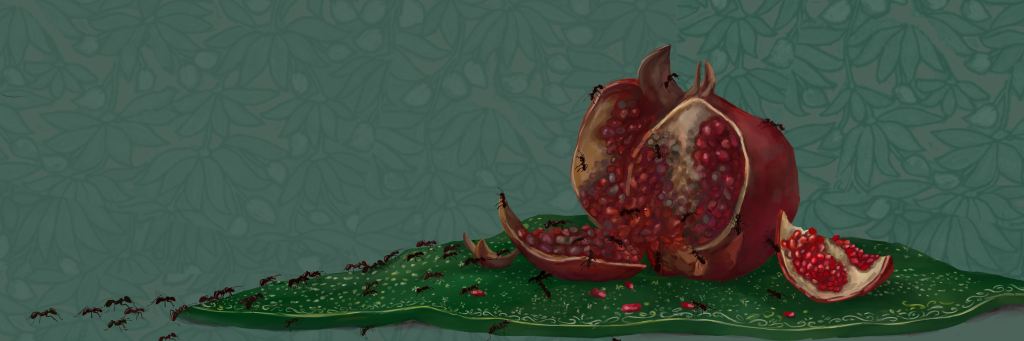
It all started in the monsoon of 1950—or 51? It was a golden day, soon to turn grey. I had…
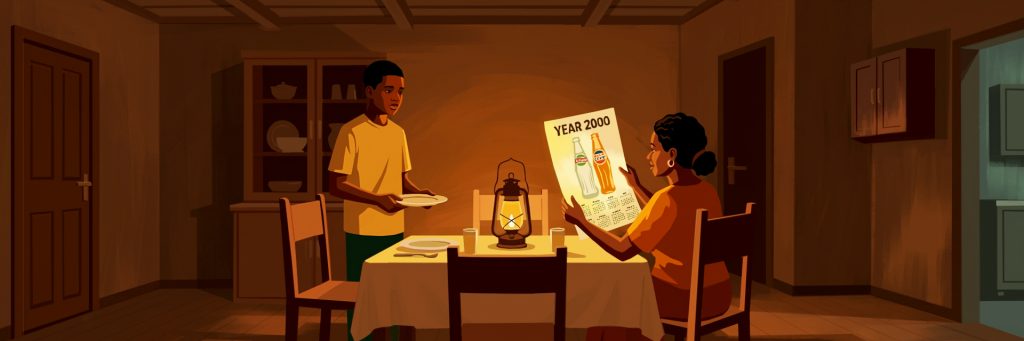
Akure, Nigeria, 1999 January: My new guardian was a performer of miracles. A pastor whose anointed touch could heal sicknesses.…
Sign up to receive new pieces of writing as soon as they are published as well as information on competitions, creative grants and more.