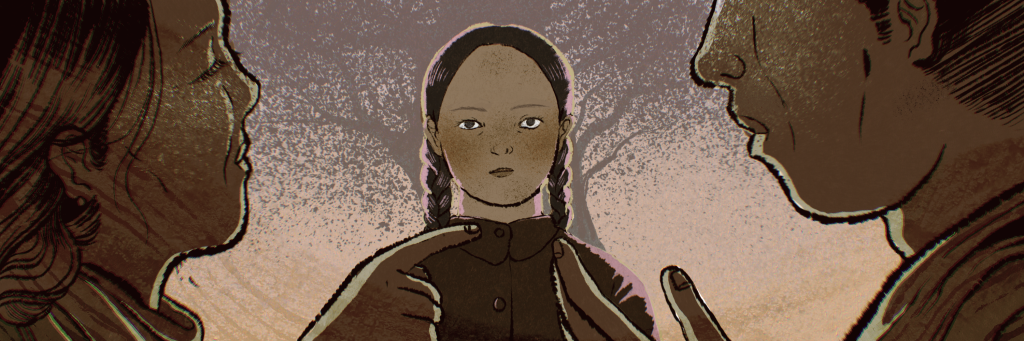
Bitter Water Village
In a rain-soaked village by a restless river, a fifteen-year-old finds her childhood collapsing under the weight of family silence…
The online magazine of new writing from around the globe
23 July 2025
Mum made us wash our feet in pee. She called us from our room — just the siblings. We descended, two tiptoeing zonbi, half awake, stepping over the hurdles of lucky sleeping cousins packed on the floor. They weren’t blighted like us, so Mum didn’t wake them.
We gathered in the kitchen. Stooping in darkness, we emptied our night bladders into the enamel potty, one after the other. Mum watched as we bent, butts bare like peeled breadfruits. But for each other, we looked away, giving privacy by denying the other our eyes. Streams of pee harpooned the bowl, released like pressure cooker hisses, ch-ch-sh three times, till it was half-filled and hot. We had long stopped complaining and complied. This was not the first time.
Mum ensured our feet were baptised from toe-tip to ankle in an inverse Achilles.
‘Do it properly’, she urged, gripping Jibyé’s thin shoulder. ‘Put your whole foot inside. Keep it there a little bit.’
As I waited for my turn, I watched him wince, his pointy features pinching to the centre of his face. It was warm when I submerged one foot, balancing with my hand against the wooden counter. I bobbed my foot like a tea bag and dried it on the old towel Mum had spread on the floor.
Home was not ours because it belonged to everybody else. It was the transition place for nomads, vagabonds and criminals — all family, of course. With a welcoming wave inside and a poor djab, yich mwen, Mum reeled them in. They made themselves at home, spreading their legs and lives into our space. When they were ready to go, they left, and others would come, and it was the same again, more bodies to squeeze past in the hallway, each one moving in like another layer of dirt filling up a hole, with us at the bottom. But that’s not why Mum made us do the pee thing.
I went back to my room after bathing. Jibyé was asleep on the floor, and a cousin was sleeping in my bed. Spittle had dribbled and dried into a white stain on her cheek. She already had that shit smell that carried on her breath every morning. I watched her big breasts stretch my favourite nightshirt, the plastisol eighty-nine cracking under the strain.
Her nose curved broad in the air. She growled. Air grated against her throat as it escaped from her loose-lipped gape. I squeezed her nostrils and mouth shut, my thumbs and indexes like sutures. I released her just before she jerked awake and slithered across the sheets to lay on my side. Her heavy breath blew on my cheek. She breathed in my hot air and dreams. The only thing I owned was the sliver of black between myself and my skin when I closed my eyes.
When I woke up later that morning, I knew when he entered through the doors. It was as if his body stretched the house. The wooden boards bowed into the foundation. The ceilings creaked, recoiling from the top of his Panama hat, which was now perched brown and lofty on his crossed knee.
I watched him, through the lace curtain that cordoned off the corridor, sitting at the table with his missing piece of ear. He leaned the dining chair onto its back legs — Mum never allowed us to do that — and tilted his head back, eating the room through slitted eyes. A long arm carried the only unchipped teacup from his thin lips onto the white tablecloth, ignoring the saucer. He was the reason we did the pee thing.
‘I paying the mortgage now’, he said.
Mum was facing the counter. She watched him from around her temple as she packed patés with brown meat filling to sell to the Castries people at lunchtime. Her quick fingers sealed the white dough pocket with a dependable seam. Nothing at home was ever as certain as that.
‘I grateful for that. Thank you’, Mum said, shutting the rusted oven door against the dusty bellies of the pastries.
‘Bring one of them buns for me.’
Mum took a sugared bun from the pile on the counter and put it on the saucer in front of him. His jaw clenched and unclenched in ravenous bites, exposing the bun’s soft insides.
Things are always more vulnerable when they eat. I decided to take this chance to go outside before I was noticed. Brushing past my curtained hideout, I sneaked toward the open door. I didn’t make it halfway across the room.
‘Malonette, come and wash the wares for me.’ Mum interrupted my escape.
My mouth wound into a rude knot. I mumbled an ‘afternoon’ as I passed him and dragged my feet into the kitchen. I pushed the sink handle. The faucet hissed curses at the dirty dishes under its silver tongue, licking away stains with begrudging indifference.
‘Gi’ me some water’, he demanded.
Mum opened the cupboard door to retrieve the tall glasses set aside for important guests.
‘Make the girl pour the water.’
‘You can come for your own water’, I retorted. Mum’s wedding ring clinked against my teeth. My lips burned from the backhanded slap.
‘Pour some water for your uncle’, Mum whispered.
I dropped the soapy dish into the sink and took the glass from Mum without wiping my hands. I filled the glass almost to the brim so I could walk slowly. I wanted to spit in the water and watch him drink it.
He looked at me as his fingers wrapped around the glass, eyebrows raised in annoyed amusement. I met his eyes. He watched me as if I was a blurry blob of flesh, like when you unfocus your eyes and see only the outlines of things. His eyes were empty, but something strange moved behind them. A dark and oily thing. It reminded me of a cousin who enjoyed crucifying lizards at the back of the house. My toes recoiled, crunching together. I looked at his lips instead. They were parted in an ‘o’ to sip the water. Pink like a dog’s butthole opening just before it was about to shit.
He decided to stay in the house from that day. He took Mum’s bedroom. All the cousins scattered, leaving us behind. Jibyé, Mum and I squeezed into our tiny room. And like the house, we stretched against the fleshy seams of our bodies and held onto each other to keep ourselves from bursting. That’s when the redeye cat appeared.
*
There was an old kitchen outside. It was a small shanty with a leaning roof and a bare floor. Mum used to cook in there long before the inside kitchen was built. He had now made it his office and stayed inside it most of the day.
I’d hear when he opened the bedroom door in the mornings. Lying in bed next to Mum, with Jibyé alert on the floor, we’d listen to the 15 squeaks as he walked down the stairs. At the last squeak — that’s when we’d all get out of bed.
Mum never asked what he did in the old kitchen because she already knew. His food was always on the table when he’d return to the house for lunch. Mum would find a reason not to be in the house then. She’d rescrub the front yard with Jeyes fluid and turpentine even though the concrete was clean, or she’d wash clothes that she could keep until the weekend or burst open stitches she’d sewn the day before to sew them again under the scrawny mango tree.
Jibyé and I watched the old kitchen during the day. Jibyé didn’t want to at first. He was scared, but I convinced him that watching would protect us. I didn’t tell him I was scared, too. I didn’t want to do it alone.
Mum had an old cupboard downstairs that was her makeshift coop for the yard fowls she’d feed in exchange for their orange-yolked eggs. But all the fowls disappeared ever since the redeye cat came to the yard. Mum grumbled about having to buy eggs, cursing the redeye cat on her walk to the shop.
The cupboard smelled of chicken, but we did our best to clean the floor and pile the dirty wood chips into a corner. We were short enough that the shelf barely grazed our heads if we crouched. We angled the cupboard to have a clear view of the old kitchen and its comings and goings. The cupboard door was full of holes — our peepholes — that allowed us to see out. But no one could see us.
People came into our yard daily, bypassing the front of the house to walk along the thin alley leading to the back and the old kitchen. He always kept the door shut. So, Jibyé and I would guess what each person came for.
‘That one in the tight dress must be a jabal coming to tie a man’, Jibyé laughed.
Snickering, I would reply, ‘And look, that one with the threading shirt is the wife coming for something to prevent the jabal from taking her husband.’
We always knew when it was court day, too. People came dressed in their tight-tight suits, looking anxious, stuffing folds of parchment paper into their jacket pockets or hiding rounds of leaves in their purses as they left. Sometimes, men with big rings on their fingers and kósh, golden and heavy in their necks, would come out with their hair dripping and smelling of herbs.
The yard started stinking and became more pungent every day. The smell would travel. Sometimes, it was stronger at one end of the yard and then the next day at the other end. Mum had us scrounging around the yard, looking for what had died, but we never found it. She stopped making us search for it after he became agitated and told her to stop minding his business.
Today, it smelled like whatever it was had to be in the cupboard. The people stopped coming around sunset, and the silent concrete yard retracted into itself. The sun was just behind the old kitchen, opposite the cupboard. Our peepholes allowed intruding fingers of light inside. They cut golden slits into the rotted wooden floor, stretching towards our dirty-nailed toes.
It was stifling inside the cupboard, and the smell was overpowering. My upper lip moistened with sweat. Jibyé passed a grubby hand over his forehead. I stretched my legs, lifting from a crouch. As a routine, we’d waited for the sky to turn purple, casting the yard in mauve shadows. Then, when the streetlamps came on, we ran into the house barebacked and black-footed. We didn’t want to be outside when the redeye cat came. But today, the smell made it difficult to stay in the cupboard.
‘I cannot take that smell again’, Jibyé cried. He banged his head on the shelf above in his hurry to get out. The thin plywood juddered with the impact. Grimacing, he placed a hand on the crown of his head.
I wasn’t looking at him, though. My attention was on the dangling thing between us. A clear string, beaded with the heads of all six of Mum’s yard fowls, was hanging over the ledge of the shelf. Jibyé noticed, too. For a moment, we stared at the closed-eyed faces hard with rot. Then we scrambled out of the cupboard. We decided it was dark enough outside.
I burst into the house, chest heaving more out of fear than tiredness. Jibyé tripped behind me as we walked into the dining room. The smell of coffee was strong. We took two teacups from the cupboard and bolted upstairs.
Mum was on the tiny balcony listening to the night song of a serenading cricket. She sipped from a steaming mug after nibbling on a milk chocolate square. Our teacups prodded her until she tilted her mug to dribble some of her coffee inside. Then our hands unfurled in patient white-palmed asking until she placed a square of chocolate in each.
The cricket stopped singing. I listened to Jibyé sipping loud and wet from the cup.
‘Stop drinking so loud’, Mum murmured as she stared over the balcony, eyes far-seeing. She wasn’t here with us.
A shadow landed on the balcony railing. I stared at it as it padded the length of the balcony, staring at us with every step. Its body was long and lean, and its ears were large, one missing a tip. A normal-looking cat. But, when it looked at me with those red eyes, I felt as if something rough grated my skin. My face felt raw, and the feeling made me want to scream. The redeye cat stretched and yawned.
‘T’iefing cat!’ Mum screeched, flinging her mug at it. ‘Get out of my house!’
The mug sailed over its target and broke somewhere in the dark. The cat walked to where the balcony joined the house wall. It presented its backend and sprayed the peeling blue paint with a thin jet of liquid. Never breaking eye contact with Mum.
Jibyé rushed into the house. I watched Mum, with her trembling hands and small head tied tight in a white scarf. I hated her then. Her weakness shamed me. She couldn’t scare away a stupid cat. I got up. The red eyes were on me — mocking. Even to a cat, I was nothing.
*
Jibyé and I didn’t return to our sentinel posts in the cupboard. We were crouched in the front yard, trying to spit into the gutter without hitting the wall. Our game stopped when a group of important-looking people came into the front yard and walked to the back. They never glanced at us.
‘That little man in the suit looking like a politician they show us in school’, Jibyé mumbled.
We were debating why we thought a politician would come to the old kitchen when we heard shouts from behind the house. Then, the little man and his bodyguards strutted out of the yard. A moment later, he came around the alley, watching the retreating entourage of men, his hands on his head.
I tried to pull Jibyé into the house before he saw us. But like a predator, he must have smelled our sweat and the fear leaking into it. His head whipped around. He saw us.
My breath hitched. The dark and oily thing was at the front of his eyes. He stalked toward us and yanked our arms, dragging us to the backyard.
‘You interfere with my things?’ he snarled, dropping our arms.
We were in the backyard, in front of the old cupboard. He flung the doors open and pulled out the hanging string of fowl heads.
I was silent, staring at the ground. There was a loud crack.
Jibyé whimpered.
I looked up and saw Jibyé cringing away. His upper body curled down, and his hand cupped his cheek.
‘I ask if you interfere with—’ He never had a chance to repeat his question. I sprang at him, scratching at his eyes and trying to bite any flesh that came close to my mouth. Jibyé, red-cheeked, grabbed his leg and bit into thigh flesh. He bucked and tried to shake us off, but we clung to him like ticks, so he called for help.
Mum came rushing into the backyard. A sharp slap on the bottom loosened my grip. She pulled Jibyé up by the ear, oh-ing and ai-ing.
‘You have animal children!’ He rubbed the swelling oval bite marks on his arms.
‘He slap Jibyé!’ I cried.
‘Doh touch my things.’
He picked up the string with Mum’s yard fowl heads before stomping back to the old kitchen. The fowl heads dangled in silent screams toward the ground.
When the old kitchen’s door closed, Mum beat us, and I knew she did it because she could not beat him.
*
My lip had stopped bleeding, and it was night now. Jibyé sat moping in a corner. I glared at the empty coffee pot and forced the grounds through the drain in protest. I tried not to slam the dishes, but I wanted to break something. An intentional accident.
‘Come and dry the dishes, Jib.’ I splashed some water from the pot at him.
Jibyé sighed before getting up from the chair. I nudged his shoulder with my own as we stood beside each other.
Mum appeared in the kitchen. Jibyé flinched. My eyes widened.
‘You surprise to see me in my own house?’ We continued with the dishes. Mum placed a saucer with two uneaten squares of chocolate by the sink. I didn’t touch them. Her lips made a popping sound as if she opened them to say one thing but changed her mind.
‘Malonette, you bring the clothes inside?’
I dropped the saucer I was washing, ‘I—I can—will get it tomorrow.’
‘Your head hard them days.’ — Mum sucked her teeth — ‘Go and get the clothes.’
‘But Mum, the cat — I mean, it dark.’
‘Now.’
She followed me outside. I went around to the backyard, giving the old kitchen a wide berth. It was deep in shadow, and the lime tree behind it made the old kitchen look like a shadowy chicken head. I hurried toward the clothesline at the other end of the yard.
The clothes hung like flayed skins in the breezeless night. I unpegged them as fast as I could, but Mum was faster. Anger made her movements rough as she slammed bundles of clothes into the basket, muttering about disobedient children. We were on the final clothesline near the perimeter wall, and she was still muttering.
I was taking down the long white bedsheet when two red eyes leered from the darkness on top of the wall. The redeye cat flew at my face, clawing at my cheeks. I screamed, stumbling backwards. I fell onto the ground.
‘Mum! Mum!’
The cat wriggled from my grasp when I pried it off. I kicked at it, trying to keep it away. Its black fur was frazzled, and its teeth gleamed white. I crawled backwards. Its back arched and haunches bunched as it prepared to pounce.
A large rock cut through the night and cracked against the cat’s black head. The head whipped to the right, and the cat fell onto its side. Sometimes, I hear cats scream when they mate, but this cat released a human howl. I shuddered, feeling as if my body was covered in dark, sticky oil. The cat scurried into the shadows. Its broken head low and dripping blood.
Mum helped me up, picked up the filled laundry basket and walked toward the house. I followed her, my breath hot on her neck.
*
That morning, Mum’s frantic cries summoned me from the room. She was calling from the bedroom that used to be hers. I pushed the door open. Mum was leaning over him. He lay in the bed, his head bleeding into the pillowcase.
‘Go by Ma Alphonse. Call the ambulance.’ Mum never looked away from the crushed head.
I walked to Ma Alphonse’s house. When I got there, I asked to use the phone. Someone else was using it. I told them to take their time. The ambulance arrived sometime later, and they carried him off.
‘We will not see the redeye cat again’, Mum whispered, holding Jibyé and me close.
We walked into our house. The floorboards unbowed themselves, and the ceiling sighed in repose. And for the first time, we had space.
In a rain-soaked village by a restless river, a fifteen-year-old finds her childhood collapsing under the weight of family silence…
In an overcrowded family home governed by an unseen god, a young girl comes of age under rigid rules, until…
A Trinidadian bassist flees to Lima to escape his past, but a relentless rhythm follows him across the sea, turning…
Sign up to receive new pieces of writing as soon as they are published as well as information on competitions, creative grants and more.