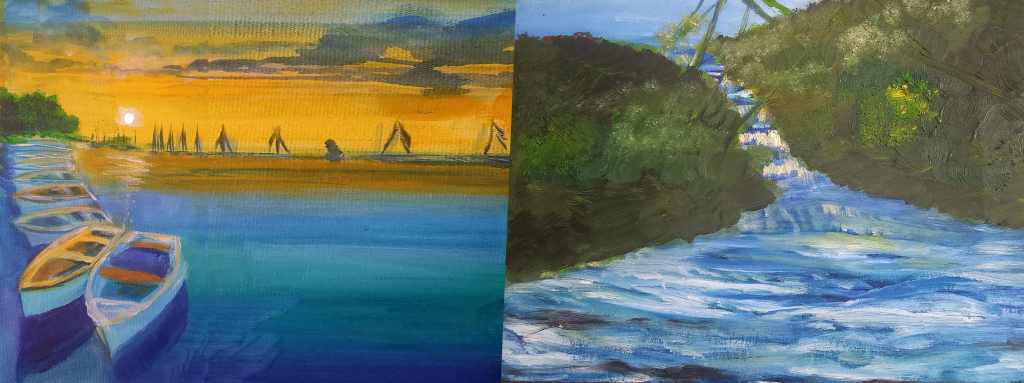
River Mouth
Evening used to come soft in Icacos, slipping through coconut trees and over cracked fishing pirogues on the shore. Lately,…
The online magazine of new writing from around the globe
14 October 2026
Akure, Nigeria, 1999
January:
My new guardian was a performer of miracles. A pastor whose anointed touch could heal sicknesses. All this Uncle Kenny repeated in a tone that suggested that I ought to be impressed, as we passed through the gates of the Calvary Church of Miracles. Trailing behind him, I struggled with the weight of all my schoolbooks in my backpack while he carried my other bag that held my clothes and shoes.
‘Are you afraid?’ He asked. He did not stop or turn around to look at me.
No, I wanted to say, but I bit my tongue in silence and focused on the back of his head as he continued walking ahead of me. I was only 15. My understanding of fear was narrow. Fear was what I felt the day a street dog chased me or when my classmates dared me to sneak out of school, knowing Mama would give me the punishment of a lifetime if she ever knew.
Mama was no more, and that meant that I could no longer live in the house I had known all my life. And that made me angry, not afraid. Angry that she left me all alone. No one, not even Uncle Kenny, who was just one of Mama’s tenants, knew how I was related to this pastor that I was to start living with. All we knew was that he was a distant relative. Only Mama knew about my parents, and she had taken that knowledge to the grave. I was a blur in the world. Untraceable.
‘There’s nothing to be afraid of,’ Uncle Kenny continued, interpreting my silence as a confirmation of his assumption. ‘You’re not changing your school. You’ll still have your friends.’
There were other things he could have talked about to take my mind off things. The presidential elections happening next month, for instance. Nigeria was finally on the cusp of returning to democracy after 15 years of uninterrupted military rule. It was all that the teachers whispered excitedly about whenever they thought students were out of earshot. Or we could talk about how unimpressive the pastor’s church was. How the building was painted in a jarring shade of blue that reminded me of the St. Louis sugar boxes. We could laugh at how the pillars holding up the front porch appeared to be leaning sideways slightly. There were no bas-relief depictions of the Assumption of the Blessed Virgin Mary or the Pieta carved onto the doors. No trees or flower beds. Not even a spread of gravel to mark the footpath. The compound was just a stretch of bare, unadorned, harmattan-hardened earth.
Through the windows of the church, I glimpsed women stacking plastic chairs in towers, sweeping and mopping the floors. I realised, with an ache in my chest, that this strange building would be my new church, that my days at Immaculate Conception Cathedral were over. I would miss rising at dawn with Mama to attend morning Mass on Sundays.
The pastor’s house was a modestly sized bungalow behind the church building, with its own fence and gate. Snake plants overlooked the open drainage that ran past the fence, their thorny serpentine leaves bearing unmistakable signs of harmattan. Uncle Kenny pushed through the gate with an air of familiarity, and I followed. A teenage girl was entertaining herself with a pack of cards on the front veranda. She took one look at the bags in our hands. And as though she knew who we were and what the bags meant, she stood up at once and quietly instructed us to remove our shoes before leading us into the house. I dropped my backpack by the door on the floor of the sitting room, but Uncle Kenny held onto my other bag.
The interior of the pastor’s house had a modern look that I instantly liked. A Sharp TV and a VCR player on a wooden cabinet fitted with glass doors. The floor, a Tetris of red and blue vinyl tiles, cooled my soles. Two leatherbound Bibles rested on a light-green Formica-topped centre table. Their spines were angled towards where I sat—one was the Yoruba version and the other was in English.
‘Should I bring you water?’ the girl asked Uncle Kenny when we had taken our seats. Her gaze darted towards me very briefly.
Uncle Kenny shook his head. The pastor was having a bath, the girl said; therefore we would have to wait for a while. Uncle Kenny shrugged as if to say, not a problem. Fifteen minutes later, I began to wonder how long it takes a grown man to bathe. A small part of me felt guilty for wasting Uncle Kenny’s time. He did not have to come here with me. We weren’t related, and so I shouldn’t be his problem.
The bead curtains hanging over the inner doorway rattled as a man parted them and walked into the sitting room, enveloped in the scent of soap. He had full hair and a beard. His white singlet revealed the patch of hair on his chest. He was not a tall man; in fact, I was taller than him and reckoned that in a few years, I would be towering over him. I was already a tall boy for my age.
‘Good morning, sir.’ Uncle Kenny shot up from his seat and bowed. I did the same.
‘My people, sit down; sit down, please,’ said the pastor, beelining towards Uncle Kenny to shake hands with him. When he extended his right hand towards me, I hesitated until Uncle Kenny discreetly nudged me in the ribs with his elbow.
‘My boy, what’s your name?’ the pastor asked when we all settled into our seats.
He chose the armchair that faced the television and crossed his legs.
‘Feranmi, sir.’
‘What school do you attend?’
I told him I attended St. Francis and that I was in year five. I would be writing my Senior School Certificate Exams next year.
‘St. Francis is a solid school for boys,’ the pastor remarked, nodding with approval and drumming his fingers against the arm of his chair. ‘The Catholics get education right. As for their approach to salvation—’ he paused and shook his head gravely— ‘God help them.’ There was no disdain in his voice, only pity for the Catholic souls he was sure would face eternal damnation for choosing the wrong path to Salvation.
We talked about my favourite subjects and extracurricular activities (I told him I loved to play football), but he asked nothing about Mama which I found strange since he and I were supposed to be related.
‘We need to bring useful skills back into the classroom for our children,’ he said at my mention of football, with a disapproving twist to his mouth. ‘Carpentry, plumbing, electrical works. Our people are looking down on those skills now—everyone wants to be doctors, lawyers and engineers, but we’ll come to regret it in the future. Every profession must be valued in a true society.’
I looked down at my toes, uninterested in the direction the conversation was taking. Harmattan had cracked my feet so bad that bits of dry, flaky skin broke off if I prodded hard enough. Shea butter or pumice rock would help, but those were back in Mama’s house—with her belongings. What would happen to everything she owned? Who would decide the fate of her belongings? The sound of Uncle Kenny, chuckling at something the pastor said, snapped me out of my thoughts. The girl was back. I did not hear when the pastor called for her.
‘Take Fe̩ranmi to his room,’ the pastor instructed her. The girl met my gaze confidently, but I looked away. We had no girls in St. Francis.
My first impression about my new room was that it was too big. The mattress was wide enough to fit two more boys, and the glass louvre windows were abundant, two on the west wall and another two on the east wall. The curtains were bundled into a bulky Y so that air found its way in, unimpeded.
‘Your name is Fe̩ranmi,’ said the girl. It did not sound like a question.
‘Yes.’
‘That’s my younger brother’s name,’ she scoffed. I did not understand her disapproval. Was she angry that I was her brother’s namesake? She was looking at the walls now, running her fingers over the fading blue emulsion paint. When she stopped, her fingers were stained blue. ‘Be careful when it rains,’ she said. ‘That part of the ceiling leaks.’ She pointed to a spot on the ceiling and took her leave.
In my newfound solitude, I lay down on the bed and watched a spider dangling from its own web on the window. The creature spun around slowly, on a strand so thin, so fine, that it gleamed silver as it caught the sunlight pouring through the louvres. The web became invisible to my eyes for a split-second, making it look like the spider was levitating. I drifted off to sleep and dreamt that I was back in Mama’s house on Carr Street, but the house had transformed into an infinite labyrinth. I wandered from endless room to endless room, searching for something I could neither name nor feel.
The next day, the pastor’s wife, Mummy Faith, assigned my portion of the house chores to me. She drew a roster for washing the dishes and tidying up the kitchen after dinner. I was assigned Tuesdays, Thursdays and Saturdays. The girl was assigned Mondays, Wednesdays and Fridays. Sundays were for both of us. I was also in charge of washing the red Toyota Starlet every morning and watering the chalice-shaped flowerpots of aloe vera and purple hearts on the veranda. I came to learn that the girl’s name was Rol̩ake̩.
The pastor had his own rules too. Every day, Rol̩ake̩ and I were to memorise new verses of the Bible. After the conclusion of morning prayers, we would stand in the centre of the sitting room and recite the verses we had learned. The only verse I knew by heart was Psalm 23—the Lord is my shepherd; there is nothing I shall want—which I learned many years ago with the other young children at Immaculate Conception. I promised myself I would be hardworking and obedient as long as I lived with the pastor and his wife, not because I liked them but because any imperfection or mistake on my part would reflect badly on Mama, the only person that raised me.
The Calvary Church of Miracles was the pastor’s full-time job. He was almost always in the church building: overseeing prayers or holding meetings and counselling sessions. I would imagine him counselling quarrelling spouses, alcoholics, unruly children whose parents were nearly giving up on them and people on the brink of despair. Years of observing Mama intervene in her tenants’ family issues had given me a glimpse of the kinds of problems that plagued people.
Four days after my arrival, I attended my first Sunday service in the pastor’s church. The service included a special segment for people to testify about the pastor’s miracles. There was the businesswoman who escaped unscathed from a ghastly car accident. The only reason for her survival, she said, was that the pastor prayed for her on the eve of the journey. Another woman had been bedridden for months until a friend referred her to the pastor. An elderly man had been wheelchair-bound for a decade until the pastor exorcised the spirit of paralysis from his body. I stopped paying attention when the fourth person began to speak. The ushers hovered nearby, ready to firmly escort any testifier who took up more than their allotted time of two minutes. The businesswoman, at the end of her testimony, announced to the congregation that she was donating two standing fans to the church. As if on cue, two male ushers bounded into the church, carrying the fans. The congregation broke into a round of applause. The performer of miracles smiled and waved in his seat.
*
February:
On the morning of the elections, the pastor and Mummy Faith left the house at dawn to cast their votes. A driving curfew had been imposed, so they had to leave the Starlet behind. They must have been gone for about an hour when my bedroom door opened. Rol̩ake̩ peeped through the opening. I had been trying to study, but after a heavy breakfast of boiled yams and fried eggs, I kept dozing off. So, I lowered the curtains and crawled to bed. Now that she was here, I propped myself up on my left elbow.
‘Come in,’ I said, even though what I should have said was, What do you want?
She had not set foot here since my first day in the house.
She shut the door behind her. Without looking at me, she walked to the windows and parted the curtains. ‘You like the dark,’ she observed, then made for the desk and picked up my New General Mathematics for Senior Secondary Schools textbook. ‘You’re in senior secondary school?’ she asked, surprised.
‘Yes,’ I answered.
The textbook slipped from her grip and fell onto the table. ‘How old are you?’ she asked.
‘15.’
There was a pause. ‘I’m 17,’ she said.
I suspected she was a junior secondary school student because of the pinafore uniform she wore to her school every day. She was older in age, but I was her senior in class. We stared at each other for a while—she by the desk, me on the bed. Then a sly smile played on her lips as she slid into the bed beside me. My heart started beating harder and faster, because I feared that someone would walk in and see us. And then I remembered that we were alone in the house. She was so close that I could feel her breath tickling my face. My inner voice screamed that this was wrong, that I should push her away or flee the room, but I silenced it. We were alone. Her neck smelled of Tony Montana talcum powder. She was watching me intently to see how I would react. In the end, I slid my hand underneath her blouse.
*
May:
With great fanfare, Olusegun Obasanjo was sworn in as the president on the 29th, and the Fourth Republic officially drew its first breath. For the first few weeks after the swearing-in, on my way to school I would stop by the kiosk near the Hospital Road intersection and let my eyes skim the front-page editorials of different newspapers. Most were optimistic, now that Nigeria’s suspension from the Commonwealth had been lifted, but also cautious, unwilling to forget past coups or the annulled 1993 elections. Other editorials asked how the new president intended to tackle the problems inherited from the military regime—a rising cost of living, the scourge of fuel scarcity, terrible roads, erratic power supply and civil servants’ unpaid salaries.
But what I enjoyed most about the brief periods I spent at the newspaper vendor’s kiosk were the stories from the vendor himself. He claimed to have once been employed as a driver by the military governor of a state. He never said which state, but he knew which officers embezzled public funds to buy empty, uninhabited mansions and apartments in England, America, Canada and Switzerland. He always mentioned the countries in that order, no matter how many times he told and retold the same stories. And he knew which officers embezzled public funds to hide their mistresses and secret children in England, America, Canada and Switzerland. Sometimes I would try to imagine what those secret-filled, ill-gotten mansions and apartments looked like and conjure up pristine, white walls, gleaming chandeliers, front yards and backyards drenched in snow and sunlight seeping softly, quietly through windows so grand that they stretched all the way to the ceiling. But my mind was simply reenacting images from the American movies that Uncle Kenny used to rent from video shops on Fridays.
Once the initial excitement started to wane, Akure swiftly settled back into its usual quiet and laidback nature. Although military rule had left some scars on our city, we were still relatively far away from the major events that had drawn the world’s attention to Nigeria during General Abacha’s regime. Unlike Lagos, where some of the loudest pro-democracy journalists and activists were targeted and silenced, and hundreds of people camped daily at the gates of the American Embassy for a visa interview, praying feverishly to be assigned to a sympathetic consular officer.
Rol̩ake̩ and I devised a plan to start seeing each other outside the house. Our arrangement was simple. I lied to the pastor that St. Francis was now holding after-school lessons on Fridays so that every Friday, I could trek all the way from school to O̩s̩inle Street, where our rendezvous point was a two-storey house, with a small clinic on the first floor and a payphone booth across from it. Ro̩lake̩ only told me that one of her friends rented a room and parlour there and was willing to let us use the place for an hour. The apartment itself was small and cramped, always boiling, always enveloped in the wretched smell of damp clothes. We would head straight for the bedroom and press our bodies against the dirty sheets against the backdrop of rats scrabbling in dark corners. Afterwards, we would leave the house in silence, each person taking a different route back to the pastor’s house.
*
July:
The pastor began the day in an unsaintly mood. He and Mummy Faith had quarrelled at dawn, and she’d left the house in the Starlet, leaving Ro̩lake̩ and me to deal with the fallout. I began to develop my own theories about where Mummy Faith could have gone. Her parents’ house maybe. Or she had a secret apartment somewhere in Akure. Never a hotel. That would bring great scandal to the Calvary Church of Miracles. After we concluded morning prayers, the pastor told me to stay back. I kept my gaze trained on the floor, but from the corner of my eye, I saw Rol̩ake̩ skulking behind the beaded curtains.
‘I saw Mr. Ojo, your English teacher, yesterday,’ the pastor began. ‘He brought someone to the church to have a meeting with me. I asked him if your school will continue the Friday after-school lessons during the long holiday.’
A pause. I felt a chill at the mention of the Friday lessons that I had made up.
‘The good man was confused,’ continued the pastor. ‘He was not aware of any after-school lessons at St. Francis on Fridays.’ His voice was calm, but I knew I was in hot water. ‘You know what they say about children who lie?’ His voice was still soft, but there was now a dangerous edge slowly creeping into it. ‘They end up becoming petty thieves, and petty thieves eventually become armed robbers, and armed robbers end up as murderers. That’s the inevitable cycle. Do you understand me?’
‘Yes sir,’ I answered, even though my tongue was heavy.
‘Tell me what you’ve been doing on those Fridays.’
I felt like my head was submerged in water. The pastor was silent. I was silent. But with every second that ticked by, my silence was turning into defiance.
‘I won’t ask again.’ The pastor rose from the armchair and began to walk towards where I sat. Then he stopped, looming above me. ‘I was once young like you,’ he said in a mellowed voice that carried a tinge of pity and melancholy. ‘I did stupid things too, but thanks to the guidance of my parents and the older people around me, I eventually came to my senses.’
I was tempted to yield, but I was afraid of what the consequences would be for Ro̩lake̩. The pastor must have noticed that his change of tack was having no effect, and this enraged him further. His left hand shot towards me, and I felt something like the crack of thunder dance across my face. My head jerked sideways with a force I did not think was possible. I expected a second slap, but he had already stormed off into his study.
Rol̩ake̩ came to me in the middle of the night, while the pastor was holding a night-till-daybreak prayer vigil in the church. It was like that first day that she entered. No knock. No invitation. I jolted awake at the touch of her palm grazing my forehead.
‘Go away,’ I said. ‘If the pastor sees us together—’ I trailed off, too frightened to even think of it.
‘Are you angry?’
‘No.’ I could not think of a reason why I would be or why she would ask such a question.
She exhaled. ‘Thank you for not telling him. I don’t know what would have happened if you told him the truth.’
‘He would have killed us,’ I said, and we laughed.
‘I want to tell you something,’ she said. ‘Promise me you won’t say anything until I finish.’
‘I promise.’
‘I had a baby last year. That’s why my parents brought me from Jebba to live here.’
My body tensed. Maybe because it was hard to picture her with child. Or perhaps because she was the kind of person that played pranks.
‘You’re not saying anything.’ Her tone was accusatory.
‘You told me not to talk until you were finished,’ I countered.
‘Okay, you can talk now!’ she snapped.
I sensed that she was embarrassed to reveal this side of her to me. ‘Why are you angry? Are you afraid that I’ll make fun of you?’ I asked.
‘You wouldn’t be the first,’ she replied.
I was quiet for a moment. ‘Where is the baby?’
‘With my mother. I’m not allowed to go back home until I finish school, and—’ the rest of her words dissolved into silent tears. I reached for her hand in the partial darkness.
Mummy Faith came back the next day, but Rol̩ake̩ left for school and did not return. The search for her instantly became an adult affair. If there was any progress or update, I knew nothing about it, and I dared not ask the pastor or Mummy Faith. I was expected to carry on with my life as though nothing had changed. I still woke up at my usual rising time for morning prayers, memorised Bible verses, did my chores and went to school.
*
July:
Two and a half weeks had passed since Ro̩lake’̩s disappearance when the pastor called me to the sitting room one night, after dinner, and informed me that she was safe. It turned out that she never went to school that morning. She headed to a motor park and boarded a bus bound for her parents’ house in Jebba. The pastor summarised everything so casually that he could have been passing a comment on the Papa Ajasco sitcom airing on the television. The adults I lived with had known this for some time, and I was only just being told.
‘Thank you, sir,’ I said when he finished talking, even though I was not sure what I was thanking him for.
The following day, I scrubbed what used to be her room of her presence. I gathered the things she left behind inside an old sack of rice. All her school exercise books and textbooks, the Tony Montana powder she always dabbed on her neck and armpits, the floral dresses and skirts and blouses she liked to pair with a green hat and fringed scarves on Sundays, the banana-flavoured chewing gum in yellow and blue wrapping hidden inside the pillowcase, the small bottle of clear nail polish tucked away under the bed. I swept and mopped the floor, soaked the bedding in detergent and water overnight. And yet, the scent of her lingered in the room. Or perhaps it was all in my head.
Five nights later, I was in the dining, clearing plates smeared with dried crusts of iyan and efinrin soup when Mummy Faith entered, holding a wall calendar. The power had just gone off, so I was working in the light of the kerosene lantern. With Ro̩lake̩ gone, my chores had doubled.
‘See this new calendar.’ Mummy Faith flipped it around like a reveal of something special. It was not until my eyes settled on YEAR 2000 printed in bold across the top edge of the calendar that I realised that it was for next year, which was still several months away. Pictures of Limca and Gold Spot bottles floated around the evenly spaced grids of the days and weeks that would someday be called January. The calendar was glossy, and the lantern’s glow bounced off it like oil on water.
‘It’s for next year,’ she added in case it was not obvious to me yet. Her beatific smile was infectious, but I was still in a very sour mood. ‘Did you know that next year is the beginning of a new millennium?’ She did not await my response. ‘I’ll hang it in the sitting room,’ she continued. ‘Do you like it?’
‘It’s fine, Ma,’ I replied. There was something about the way she said new millennium that made me repeat the words in my head. I had not thought of the coming year as the start of a millennium. It had always been just next year to me, but now it felt grand. ‘I like it very much, Ma,’ I added.
Evening used to come soft in Icacos, slipping through coconut trees and over cracked fishing pirogues on the shore. Lately,…
It all started in the monsoon of 1950—or 51? It was a golden day, soon to turn grey. I had…
“There are no innocents; there are only those who have not yet suffered.” —Ivo Andrić, The Bridge on the Drina…
Sign up to receive new pieces of writing as soon as they are published as well as information on competitions, creative grants and more.