
Arewa Girls
We were girls once. The girls you once saw hawking on the streets of Arewa—selling awara, wainan rogo, dan wake…
The online magazine of new writing from around the globe
17 August 2026
It was not surprising that the residents of 58th Street did not notice Miss Alice’s unusual condition right away; she went unheeded on any given day. A nearly destitute, faded and reclusive old woman living alone at Lot 17, she had long become invisible in the community. When she decided, without warning, to encase herself in a cocoon, no one, not even her closest neighbours, noticed for some time.
They might have continued not noticing, had it not been for that shiftless little vagabond, 10-year-old Bosie, who had entered her yard to steal ripe mangoes from her heavily laden tree.
The huge, ancient, Buxton spice mango tree grew close to the old woman’s dilapidated house. Its unpruned, vine-covered branches hung dangerously over the leaning structure, enveloping it in a tangled mass of greenery that effectively hid most of the house from view and, quite possibly, prevented it from achieving its eventual goal of total collapse.
Around the house and the tree, the rest of Lot 17 was tall grass and overgrown bushes. Here and there, among the choking weeds, a stubborn, straggly peach bougainvillea or lavender cape myrtle shrub served as a vague memory of what had once been a beautiful garden.
The Buxton spice survived and thrived in this neglected space. It had started life as a seed thrown carelessly on the ground. Never needing care or attention, it grew into a tall, healthy tree, producing deliciously aromatic, mouth-wateringly sweet mangoes season after season, as the years went by.
When Bosie came to visit, he waited until late in the afternoon and did his best to go unnoticed. This called for a calculated degree of cunning on his part, for invisibility was not an easy mode for Bosie to assume. Unlike Miss Alice, who went unnoticed without trying, people made it their business to notice Bosie as much as possible, and with good reason.
He was not from 58th Street. He lived in a little shack with his family many streets away, but Bosie did not limit himself to his immediate locality. Roaming at will, wherever fortune directed him, he was adept at reaping what he had not sown. Borrowing footwear and items of clothing he had not asked for and never intended to return or claiming the odd tool that had been left unattended by its owner, he was, in general, a well-known and disliked nuisance to the neighbourhood. Fruit trees on private properties were his special targets, and gates, open or closed, did not deter him.
Sometimes he went to school, but most of the time he did not. He was one of those unfortunate children who had fallen through the cracks of the public school system, with very little effort made by anyone to pull them back in again.
On this afternoon, he sauntered carelessly past a gateless opening in the old wire-meshed fence around Miss Alice’s property, eyeing the clusters of ripe mangoes as he passed. But he did not walk up the narrow path through the opening when he finally made his move.
This was not Bosie’s first foray into Miss Alice’s yard. A frequent visitor when mangoes were in season, he had his own very discreet means of entry. Concealed by the tangled stems and dense foliage of a golden allamanda vine that had completely taken over one side of the fence, he squeezed his thin body through a little-boy-sized hole in the rusted wire and crept stealthily up to the tree.
He knew that his visits were not secret from Miss Alice. She had seen him many times as he climbed and hung with monkey-like agility among the branches, high overhead. But she had never shouted at him, and her age and infirmities made it impossible for her to chase him off, like most other people did. After he had eaten and filled his pockets, he often left a handful of mangoes on the front porch or at the bottom of the steps, for her to find later.
On this evening, he was in a hurry and did not look around as carefully as he usually would, so he did not notice the odd-looking object hanging from the rafters of the sagging front porch until he was well up in the tree, crawling precariously along a narrow branch towards an extra-large cluster of fruit. Something at the very edge of his peripheral vision made him turn his head to get a better look. The thing, vaguely human-shaped and encased in brown, leathery-looking skin, hung upside down in the cool gloom of the porch.
Bosie fell out of the tree and landed hard on the ground.
Scrambling to his feet, his first instinct was flight. But the object did not move, and his childish curiosity made him pick up a long stick that was lying on the ground nearby and poke at the thing. It twisted in the air, suddenly and violently.
Bosie’s screams of pure terror, as he flew down the path, brought the neighbours rushing out of their homes to gather on the street in front of the old woman’s gap. Word travelled quickly, up and down the street, and a crowd soon formed. The neighbours stood in the street beyond the fence, pointing and craning their necks, whispering and wondering. Staring in bewilderment at the cocoon, they tried to make sense of what they were seeing.
‘But y’all even sure is she in deh?’ Marva’s bony hands trembled nervously as she spoke, and she clasped them tightly together. She lived obliquely opposite Miss Alice and was trying and failing to remember when she had last seen the old woman. That such a thing had occurred right under her nose, and gone unnoticed for God knows how long, was making her feel a troubled sort of guilt. Though she didn’t think she should feel guilty when she hadn’t done anything.
‘Go check an’ see, Marva.’ This second woman was shorter and broader than Marva. Big eyes in her moon-round face peered inquisitively through the leaves, trying to see better the strange object hanging on the shadowed porch. She lived at the very end of the street and, until this development, had never even remembered that Miss Alice existed.
Marva didn’t like the idea of going there herself. ‘Baz, yuh can’t go in and check for us?’ she said, turning to her husband standing just behind them.
‘Who, me?’ Baz looked mutinous, mouth pursed, broad nostrils flaring as he glared at his wife. He stepped back, away from the two women, to stand beside bespectacled Mr. Reid, who lived with Mrs. Reid and two little Reids in the big, two-storied house with grilled windows at the head of the street. The little Reids had pushed as close to the front as their combined courage allowed, but Mrs. Reid was standing far back with her best friend, Imo, both attempting to cultivate a sophisticated air of detached interest in the situation while keeping a watchful eye on the children.
‘A natural progression of human evolution,’ Mr. Reid said, to no one in particular, trying to sound like such sights were on par with his knowledge and expectations. ‘I saw something similar on the internet a few days ago. The climate is changing, folks. It’s getting real hot now, and we’ll all have to turn into lizards or burn up. I’d say she’s got a head start on it already.’
‘For real! If you saw that, then it got to be the truth. Must be happening a lot outside but is only now it reaching we here.’
‘Well, it kinda makes sense when you think about it, and if that’s the case, then she knows what she’s doing.’
‘But we can’t just leave she like that, can we? We should call somebody, or something.’
‘The police?’
‘Nah, not them, she ain’t dead, and them might want shoot first.’
‘The hospital?’
‘Eh-eh. Them will just try to cut she out, and that will kill she for sure.’
The debate and uncertainty continued up and down the street as darkness fell. Most of the residents of 58th Street thought that something should be done, but no one wanted to be the one to do it. They were not even sure what sort of action was required in such a case.
If Miss Alice, a woman whose very existence had never amounted to more than a silent, destitute shadow on the perimeter of their collective awareness, had voluntarily decided to encapsulate herself like this—and from their point of view, she must have done it on purpose—would their intervention make her situation any better? Wasn’t this, in a sense, an improvement of her general condition anyway? As the shock wore off, the consensus began to lean heavily towards non-interference.
Shadows deepened as the streetlights came on. Still troubled, yet unresolved, the crowd gradually broke up, and the neighbours drifted back to their own homes, leaving the undisturbed cocoon hanging in the darkness of the porch. They were hoping, no doubt, that Miss Alice would come to her senses without their interference and re-emerge of her own accord by morning.
But the next day, the cocoon still hung there. And the next, and the next. The police were never called, nor was the hospital, and, as more time passed, doing nothing seemed easier and more sensible than doing something that might cause more harm than good. As the days grew into weeks and the weeks turned into months, the residents of 58th Street came by less and less often to check on the cocoon.
Eventually, like the woman it contained, the cocoon became something they knew was there but had stopped noticing. It lost its strangeness with the passage of time, along with the ability to arouse further interest or concern. They walked past the gap, barely glancing in, and went about their business as before. The Reids built another extension to their already large home, and the moon-faced woman completely forgot about Miss Alice again. Baz did not go anywhere near the gap, but Marva remembered to keep an occasional eye out from the safe distance of her own yard. The grass grew even higher, and the path from the street to the house disappeared.
Months passed, and it hung there. Ignored and mostly forgotten by everyone except Bosie. He alone kept coming back after everyone else had turned their attention back to their own lives.
‘What trouble yuh looking for now?’ Marva shouted at him as his shadow slid along the side of the fence. She had seen Bosie creeping around Miss Alice’s yard regularly and had taken it on herself to bark from across the street whenever she saw him, in an effort to let him know she was keeping a lookout of sorts.
Bosie didn’t stop to tell her; he skittered away from her strident voice and slipped through the hole in the fence.
From a small clearing that he had flattened in the tall grass a short distance away, he sat and watched the cocoon.
The Buxton spice blossomed again, the tiny, yellowish-white flowers becoming small, hard, green fruits that ripened into plump, yellow ones. Bosie sat in his grass circle surrounded by ripe mangoes, juice dripping down his chin as he ate his fill and watched the cocoon. He got used to the shape of it, not seeing it in an ominous light any longer but as something that had become friendly and familiar to him. He could sit for hours looking and quietly marvelling at the intricacy of its creation. How the fibres had been tightly and skilfully woven into a smooth casing, completely enclosing Miss Alice.
He noticed that the threads at the top end, where the feet were, had been braided, then looped and re-looped into a strong web, holding the cocoon firmly to the rafters of the porch, and he wondered how long it had taken Miss Alice to weave it. He watched it gradually change colour from reddish-brown to a pale gold, like the natural aging of dead leaves on the ground.
Sometimes the cocoon wriggled a little as he watched, and, at first, Bosie would beat a hasty retreat. But he always came back. After a while, he stopped running away. Movement meant that Miss Alice was alive in the cocoon, and that assurance was more comforting than the thought of her dead and slowly disintegrating in there.
There were times when he felt that Miss Alice opened her eyes in the cocoon and watched him through the skin of it as he sat there. Somehow, that thought did not frighten him, any more than those times when he had climbed up the mango tree in the past and seen her head turn to watch him through the window. There had never been any hostility in her gaze then, and he felt none in the presence of her cocoon now.
He liked sitting there, preferring the silent company of the cocoon to the loud voices at home. He got away as often as he could from the stench of sweat and alcohol, mildew and fear. He escaped to the clearing and the cocoon to get away from the sounds of his father cursing and his mother screaming. From the sound of things breaking. From his older brother laughing mindlessly on a molly high and his baby sister crying with hunger, the same hunger that was a constant hollow in his own belly.
The small clearing surrounded by tall grass became his sanctuary, his place of peace. And avoiding Marva’s watchful eyes from the other side of the street became easier each time. Miss Alice was nearby but distant enough to be safe. Wrapped up tightly, she had locked herself away in a space she had fashioned for herself, where no one else could get in. It had not been forced on her: it was something she had chosen freely to do. Bosie wished it were in his power to make one for himself; he’d hang his cocoon next to Miss Alice’s. They’d be company for each other, he thought, each in their own world, yet not alone. And he’d never have to go back home.
#
Early one morning, a full year after Miss Alice had hidden herself away in plain sight, a split appeared on one side of the cocoon. The street outside was beginning to stir to the new day, but in the quiet of the porch, there were no witnesses to see the long, slender fingers that came through the split, pushing and tearing at the opening to make it bigger. A slim, pale creature, with small, wrinkled wings folded tightly against its shoulders, emerged slowly and laboriously, big, luminous eyes blinking in the light.
Leaving the now torn and deflated sack of its cocoon still hanging from the rafters, it crept out from the shadows of the porch and made its way over to the small clearing, where the trampled grass was bathed in early morning sunlight. As it crouched there in the warm sun, its pale skin changed to metallic green, and the orb-like eyes deepened to a rich violet hue, like two perfectly cut and polished amethysts. The tiny, wrinkled wings unfolded like tissue paper, growing and filling out into large, broad wings of bright gold, with green, silver and black markings.
The butterfly-woman, who used to be Miss Alice, stood up and stretched carefully, as if testing her strange, new body. She flapped her wings tentatively, then faster in a whir of colour and iridescence.
Satisfied that they were ready for flight, she made a small leap into the air, and the shining wings bore her upwards, into the full light of the sun.
Bosie was crawling through the hole in the fence when the butterfly-woman rose suddenly up from the ground, stretching and flapping her wings. He stared in awe as she leapt into the air, and without thinking, he ran out into the open.
‘Come baaaack!’ he shouted after her. ‘Come back!’
For a moment, he saw her pause, wings trembling in the air. Then the moment passed. She did not look down, nor did she turn back. She rose swiftly, higher and higher, until the sun, reflecting brightly off her wings into his eyes, made it impossible for him to see her any longer.
His shouting brought Marva out of her house. She had not seen the butterfly-woman in all her splendid beauty rising up into the air in a flash of multicoloured light; she only saw Bosie standing alone in the tall grass, staring up at the sky.
‘Bosie!’ shouted Marva. ‘How many times we got to tell yuh, boy, stay out of people’s yards! Always where he shouldn’t be and too hard-ears to listen. Is yuh good for nothing, thieving father yuh going to end up like, always in jail!’
‘Yuh hear what I said, boy?!’ Her shrill voice had shattered the quiet of the morning, but he stood there, rooted to the ground and as still as a statue. With an indignant huff, she went back into her own house, slamming the door behind her.
Bosie had not heard a word she had said. His mind was filled with a vision of wings.
We were girls once. The girls you once saw hawking on the streets of Arewa—selling awara, wainan rogo, dan wake…
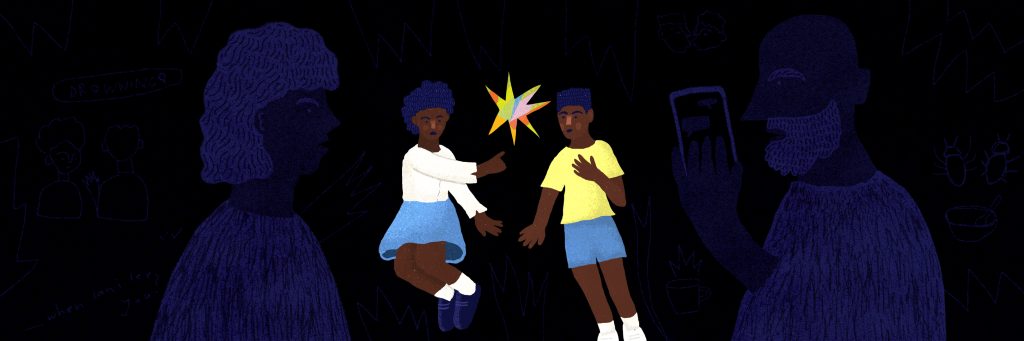
The new game Oyin and I invented is called Shock-Me-I-Shock-You. We play it whenever our parents aren't around. Often, Daddy…

The KrisFlyer miles of a dead person cannot be redeemed. The woman on the hotline said it as if she…
Sign up to receive new pieces of writing as soon as they are published as well as information on competitions, creative grants and more.