
Arewa Girls
We were girls once. The girls you once saw hawking on the streets of Arewa—selling awara, wainan rogo, dan wake…
The online magazine of new writing from around the globe
4 September 2026
Our house is old. Older than any of us. The walls lean in slightly, and the air always smells faintly of dust and soap and something burnt long ago. There are three and a half rooms; not quite enough for the multitude who live here. The largest room belongs to my parents and my two younger brothers, one of whom still wets the bed. His shame always adds a sour, medicinal scent to the air. One my mother tries to smother with extra cleaning and avoidance.
The second room used to be for me and my two sisters, one older and one younger, until we gave it up temporarily for our older brother and his wife. They had come for what we were told would be a short visit, but that was six months ago, and my parents were much too polite to ask. My sisters and I had then been relocated to the third room, which was separated from our grandmother on the other side by a plank of plywood. Although her room—if you could call it that—was barely wide enough to stretch both arms.
That was 10 of us in total. Eleven if you counted the god under my parents’ bed.
The mattress itself rested on a row of cement blocks, just high enough to leave some crawlspace underneath. It was a hollow that gathered two categories of things: those that didn’t belong in plain sight and those that simply would not fit anywhere in our three and a half rooms. Deep within those shadows, the god made itself at home. I had never seen it, so I couldn’t tell you what it looked like. I’m not sure anyone in my family had either, at least not clearly.
We were told that the god was carved from the trunk of a leafless baobab tree, but no one could recall who carved it or when. One thing I always found odd, however, was how the men insisted that because of this, the god didn’t exist—that all the stories about him were made up. They would laugh and say things like, ‘Women and their superstitions!’ Which was strange, since all of us seemed somehow to obey this nonexistent god. Once, years ago, my father had bent down to check under the bed, just to put an end to the talks. He was down there for nearly a minute; too long to have seen nothing, as he claimed. When he came back out, my father’s face was dusted with cobwebs, and, for just a moment, something moved across his averted eyes. It was gone before I could name it, replaced by careful neutrality.
‘Nothing there but old, forgotten things,’ he said, brushing himself off with shaky hands. ‘Quite a lot of dust as well.’
At this, I noticed my mother’s fingers curl into the edge of her wrapper, wringing silently. In a house she worked ceaselessly to maintain, the mention of dust must have felt like an accusation. I could see it in the way she glanced at the bed and then away, frown lines deepening around her mouth.
‘I can clean it,’ she offered.
My father’s reaction was swift: ‘No.’
His voice carried the familiar authority that often ended discussions around here, and, as expected, my mother didn’t ask again. She simply nodded, her fingers finally releasing the wrapper’s edge. That ended the matter for the rest of us.
Life in our crooked, overfull house continued as normal—the only difference was that I started to grow old enough to properly notice things. Things like how the god’s rules seemed not to bind the men. Just us. Water before sunrise; my mother, sisters, sister-in-law and I hauled it for my father and brothers to wake to filled pitchers. Firewood before noon; we gathered diligently, arms aching under the weight of bundled sticks, to cook meals the men and boys would eat first and fastest. Sweeping before evening; our backs bent over brooms while their feet tracked new dirt across floors we’d just cleaned. I wondered if the reason they didn’t feel the same pressure in their throats when rules were broken was because they chose not to see the god as real. I often wondered if I could do that, too: just decide that everything was imagined and then be free. But even thinking that made my whole body stiffen with pressure, and I was reminded that the god was anything but imagined.
In the midst of this, I was also changing physically in ways that made the older women look at me differently. Their eyes would track across my body now—assessing, measuring, fussing. One afternoon, my grandmother took a few coins from the tin she kept hidden away for special occasions and bought some fabric at the market. She and my mother spent the entire evening cutting and stitching new dresses for me while I watched, the joy of getting new clothes evident in my eyes. When my mother held up the first finished dress, I hated it instantly. When I tried it on, it hung well past my knees, so long I would have to lift the hem to walk without tripping. The fabric felt stiff and heavy, nothing like the light clothes I’d always moved freely in. Worst of all, it hung loose around my frame, billowing where my old dresses had been fitted. I felt swallowed by it. Minuscule. Like I was being forced to take up less space, even as the fabric itself took up more.
‘Beautiful,’ my grandmother said.
But I didn’t feel beautiful. I felt concealed. A few days later, my mother pulled me aside—not into another room, because there was nowhere private to go, but into the corner by the water barrels where we could speak in low voices while pretending to work. She explained things about blood and shame and the importance of staying clean, staying covered, staying careful. Her words came out practised, as if she’d rehearsed them, yet her hands twisted anxiously in her wrapper the whole time. My mother spoke about how I was changing and that I must now start washing myself carefully and privately, hiding all the evidence of my womanhood. She talked about my body in terms I didn’t quite understand.
‘You’ve become a woman,’ she said, her eyes not quite meeting mine. ‘You are now a door that must be locked at all times. Do you understand?’
I shook my head no. I honestly didn’t understand what my mother was trying to say. I tried to picture myself as a door, but I couldn’t see how I was to ‘lock’ myself. My mother, noticing my confusion, sighed and tried again.
‘What I’m trying to say is you are now like fire, and any fire that burns too bright will attract fireflies. So, you must learn control. Do you understand now?’
I could see that she was really trying, so I nodded, even though I still didn’t understand. Not really. I only understood that my body, which had been mine yesterday, was today something that needed constant supervision and taming, else it would grow wild. The god’s attention had shifted, or perhaps I’d simply moved into its line of sight. Either way, I felt watched and managed in a new, different way. The old rules that had concerned the state of the floors and the kitchen fire now seemed to concern the state of me. As my mother went on, all I could think of was how close she was sitting—close enough that our knees touched, close enough that I could smell the smoke in her hair. I couldn’t remember the last time I’d been alone, truly alone. Even my thoughts felt crowded, pressed up against everyone else’s needs and presences and expectations. That night, as I lay awake between my sleeping sisters, I thought to myself how the god would never know what it felt like to live crowded. Nothing had changed about our number, but the house felt tighter than ever. Ten of us, and no room to breathe privately. I would count the god, but I didn’t know if it had lungs to breathe with. I didn’t know if it even had any human features, yet it had more space to itself than any of us—a whole private room where it was free to exist, protected and undisturbed.
After my mother’s talk, the men in the house changed, too. My father stopped looking at me directly. When he needed to tell me something, he would speak to my mother as if I weren’t standing right there. My older brother became stricter. ‘Where are you going?’ he would ask when I left to haul water, something he’d never cared about before. He started asking my younger brothers to escort me ‘for protection’. Once, when I sat on the front step in the evening, he told me to go inside. I wondered what I’d done besides grow up.
My grandmother and my sister-in-law were also both changing, although in opposite directions. My grandmother was shrinking. Not just growing thinner but actually getting smaller, as if her bones were collapsing inward. She moved more slowly each day, gripping our leaning walls for balance whenever she stood or walked. My sister-in-law, on the other hand, was expanding. Her waist thickened week by week, and her movements became more careful. She’d rest one hand on her lower back when she stood, the other curved slightly over her belly when she thought no one noticed. The women did, though. I saw my mother’s eyes tracking the growing curve and my older sister’s knowing nods. I also observed that our chores were rearranged, and my sister-in-law suddenly had more free time on her hands.
In a house this small, you hear everything. Breathing, crying, mumbled prayers and arguments. The walls between rooms didn’t reach the ceiling, so we were always within earshot of each other, even when we didn’t want to be. You learn not to listen, to make yourself deaf to what you shouldn’t know. And yet, my sister-in-law was pregnant. Somehow, in this house of watchers and listeners and bodies pressed close, it had happened. I couldn’t stop thinking about it. I wondered what would happen when her belly finally burst. Where would the space for another be cut from?
If my grandmother noticed anything, she didn’t say. No one did. This apparently would be yet another thing we all were aware of but didn’t speak of because to speak of it would be to admit that there was nowhere to put another body in this house that barely contained the ones it already held.
I also couldn’t shake the feeling that the god underneath the bed was the one orchestrating all of this.
***
My grandmother died on a Tuesday morning. My mother had discovered her when she went into her mother’s room with a bucket of water for bathing. Our guess was that she must have taken her final breath just hours before sunrise. For me, it was eerie that I had been in the thick of sleep while my grandmother passed away just across our shared plywood wall. Around the house, there was a moment of stillness that lasted all but an hour, and then my father called a family meeting.
We all gathered in our functional sitting room, listening to my father as he asked all the practical questions. Where would we wash her? When would the burial be? Who would handle the rites? The younger children cried, but the adults shushed them. I would have cried, too, but I was caught up in my own feelings, trying to remember the last thing I had said to my grandmother. I looked over at my mother—her expression was stoic, but I could guess it was not easy hearing her husband discuss her mother like that. Like not-a-person. Somewhere at the back of my mind, I could admit he wasn’t doing anything wrong. In a sense, the person who was my grandmother no longer existed.
My father went on making burial arrangements, with my brother interjecting his opinions here and there. There was no mention of the space that my grandmother’s death had created, but I knew everyone was thinking about it. This meant that, discounting the god, there were nine of us in the house now.
My grandmother was buried without fanfare the next day, and for the first time in months, there was some space to breathe. The air felt lighter than a chicken feather. It was the deepest peace the house had ever known. That moment didn’t last long anyway because barely a week after her burial, the space my grandmother left was filled.
I had woken up that day to my mother urgently calling out for my older sister. I could also hear another sound: a low moaning coming from the second room. At first, I thought someone was sick. Then my older sister sat up beside me, and we looked at each other in the dim pre-dawn light, understanding without words. The baby was coming. My sister and I moved quickly between rooms, boiling water and gathering cloth scraps. My father and brothers were nowhere to be found, but that didn’t matter. We knew what to do.
My younger sister and I weren’t allowed into the room for the later parts, so we camped outside the door, waiting. The sounds went on for hours. My brother’s wife’s cries grew louder, more desperate. Finally, near midday, I heard my mother coaching her gently, ‘Push now; push.’ Shortly afterwards, we heard a different sound: a sharp, high wail. The air around us seemed to reduce a little as fresh lungs just behind the door drank, for the first time, more than their share of breath. Eventually, my mother and sister emerged from the room, their wrappers stained with blood and birth water.
‘Another boy,’ my mother announced to us.
The words hung in the air. Not just a baby, a boy. That distinction mattered. When my father and brothers returned a half-hour later, they brought along a keg of palm wine. Neighbours stopped by to congratulate my brother who stood taller, his chest puffed with pride. ‘Another son,’ he kept saying. ‘My boy!’
All I could think of was this made 10 of us again. One mouth closed only for another to open. Our crooked house had done the arithmetic and found we were one short, so it balanced itself. By evening, my father and brother were already rearranging space. The old mat my grandmother used to lie on was dragged into the compound for airing, and her things were moved around to make room for a cradle. I wondered why the baby couldn’t just sleep in the room with his parents.
Within days, the plywood partition came down. My father said it would ‘make breathing easier’ for the new mother and baby, though he seemed not to mind that it had the opposite effect on everyone else. The extra space quickly filled with the baby’s things—bath basin, nappies, a new mosquito net that often blew into our side of the room. The line between their half and ours vanished, and soon, the cries, the smells and the tiny clothes drying on our window all belonged to us, too. By the end of the same month, it was decided that the new parents needed ‘more privacy.’ So, my sisters and I were told to relocate temporarily—yet again—into the sitting room.
My father bought new mats for us, and my sisters and I now each had one all to ourselves. It almost felt like luxury. The warm smell of new raffia and the comforting crunch when we lay on them charmed us for like a day or two. By the third night, the novelty curdled. The sitting room had no door, only a curtain that billowed in and out with every breeze from the street. So, privacy was a rumour. Each morning, we rolled up our mats well before sunrise, just in case the men needed to pass. We got dressed quickly behind wrappers, taking turns holding them up for each other. On the days when visitors came to see the new baby, we pressed ourselves against the far wall—one with the furniture. Living in the sitting room was worse than I’d imagined it would be.
Still, our discomfort was nothing compared to the men’s. Within a week, my father started complaining.
‘A man can’t even sit in his own house,’ he muttered, stepping over our mats to reach his chair.
My brother was more direct: ‘This is not sustainable. We have nowhere to go.’
The days that followed were tight with irritation. The men started stepping over us without looking, muttering whenever they tripped on a corner of mat. My mother apologised for everything, while we girls tried to make ourselves more invisible than we already felt. But invisibility is hard work, and, in a house like ours, even silence took up space. One evening, my father called a family meeting—the second one since my grandmother’s death. We girls stood in a corner of the sitting room while the adults discussed our future as if we weren’t there.
‘The house is too small,’ my father began. ‘It’s time we addressed this properly.’
My heart leapt in my chest. At last, I thought, Dad will ask my brother and his family to find their own place. I imagined the walls breathing again and sunlight falling on the space where the baby’s cradle currently stood. I imagined my sisters and I returning to our room—not the one we shared with our grandmother first and then our brother’s baby, but our original room with the bed. We would keep the mats in the corner for when we wanted to sit close and talk. However, what my father said instead beat my heart back down, forcing it to find its place among the knots in my stomach.
‘Two of our girls are now of age. They have become women, and it’s time to find husbands for them. Starting with the oldest.’ His words sounded like this was a sacrifice being offered to the god.
My sister was married three weeks later. The arrangements were made—a man from the next village, with hands that looked too big for her waist. The women sewed and cooked; the men exchanged greetings, and no one but me seemed to think about the speed of it. The morning after she left, there was noticeably more space in the sitting room. I could stretch my legs without kicking anyone. My younger sister and I each had more room to spread our mats and ourselves. Still, the house felt just as crowded because, for one, the men didn’t stop complaining.
‘A little better,’ my father said, surveying the newly available space where my sister’s mat used to lie. ‘But not enough.’ My brother simply nodded. I knew what that meant. The house needed to shed another person, and it had already chosen whom.
Weeks folded into months, and the baby began to crawl. The men’s irritation softened a little but didn’t vanish. Like the god, it only waited. It wasn’t long before my father started speaking in parables again, with phrases like ‘We must think ahead,’ and ‘This house cannot hold everyone forever.’ The house seemed to agree. The walls leaned even lower, and the floors creaked more often. Around me, I could hear the same murmurs I’d heard when life was being decided for my older sister. And in a similar fashion, I wasn’t asked. I was simply informed. First, by my mother, in a too-high voice that seemed to strain her features, and then by my sister-in-law who had heard from her husband that my husband-to-be was a good man. The entire process required less than my sister’s had; my father worked from experience. The god under the bed stayed quiet through all of this, although I could feel it there—listening quietly. I began to hate the silence beneath that bed more than the noise above it.
The night before my wedding, I couldn’t sleep. For the first time since I became aware of my mind and imagination, I wished the night would go on forever and that morning would never come. Morning meant the end of the only world I had ever known, crooked and crowded though it was. Morning meant the heavy, starched ceremonial wrapper would be tied around me, transforming me from person to thing. I felt like I imagined my grandmother did that day as we discussed her disposal in the sitting room. I would be exempted from the chores that morning because by the time the last bundle of firewood was gathered, I would already be in another house, serving another god and learning new rules.
The night before my wedding, the moon was bright enough to make shadows of everything. I sat on the edge of our mattress, listening to the noise of the day fade away into the darkness. When it got quiet again, I stood. The house didn’t resist—it was used to women moving around quietly in the dark. I walked past sleeping bodies until I reached my parents’ room. Their bed stood exactly as it always had, with the god crouched underneath. It and I, the only two beings wide awake in our crooked house. For the first time in my life, I didn’t bother wondering if the god could hear my thoughts—not because I felt particularly brave but because there was nothing left in me but fear. Clean, clear, bone-deep fear. I had come into my parents’ room determined to do something: what that something was I believed I would figure out when I got there. But standing barely two feet from my sleeping parents and the very-much-awake god under their bed, I had no idea what to do.
Finally, I knelt down and ducked my head into the opening, staring into the dark. The air under the bed was warmer than I expected, trapped with a thick stench of urine—evidence of my younger brother’s efforts. Having spent my whole life in active practice of how to ration breath, I knew the technique: do not inhale too deeply, but take shallow, measured fragments of breath. Careful sips of air; in through my nose, out through my mouth. Just enough to keep from coughing not enough to hold the dusty, smelly air. It took my eyes a few seconds to adjust to the view. The darkness around me thickened before it loosened, and then the shapes began to form. I could make out the edges of the concrete blocks carrying the bed, a deflated rubber football and my mother’s old portmanteau repurposed as a storage box. Nothing godly or sacred there at all. It was just as my father had said: old, forgotten things and a lot of dust.
I didn’t even have a second to really feel my disappointment because someone above me shifted slightly, and the bed answered with a subdued creak. My breath caught in my throat. That had to be my father. For a suspended moment, I was certain he was awake. Somehow, he’d heard me, and any second now, he would lean over the side, calling my name and demanding to know what I was doing in the very place from which he’d banned us. I remained completely frozen. My lungs were screaming at me, but I had sooner take my chances passing out than breathing.
The silence stretched for what felt like forever, until all I could hear was the steady flow of collective respiration—the house inhaling and exhaling around me. Only then did I feed my starving lungs the tiniest morsel of air. I’d had enough chances, so I started to shift backwards, ready to crawl out.
That was when my eyes caught something in the far-right corner.
At first, I didn’t see it so much as sense it—an imbalance in the blackness, a presence where there should not have been one. I thought it was just my mind giving me a cushion of hope after the disappointment of finding nothing. But as I tilted my head, the dim spill from the doorway traced faint outlines. There! A crooked outline of something squatting against the wall; small enough to miss, but too deliberately placed to ignore. I told myself to leave it. Whatever it was, it wasn’t mine. Yet the dark seemed to lean toward it, dragging me along.
My knees bent before my mind could argue, and I found myself popping my head back under the bed. I inched forward on my elbows, stretching until my shoulder grazed the rough underside of the mattress. At that point, whoever might have woken up and caught me could go right ahead. My fingers swept through dirt and cobwebs, scraping against the side of the portmanteau as I reached farther. My shoulder was burning, and my arm trembled from the strain, but I didn’t dare stop until my hand closed around something rough, cold and surprisingly tiny.
If I wasn’t half-buried in dust and terror, I would have laughed. That was what we’d all been controlled by? It felt no bigger than a cherry mango. I bet I could have crushed it with one deft squeeze. For a moment, I just held it there, its weight absurd in my palm, the thing that had bent our backs and filled our mouths with silence. This—this speck pretending to be a god. The longer I held it, the lighter it felt, as if already losing power in my hand. Cold filled my palm and began to creep up my wrist. I knew I should let go, but my fingers tightened around it even more.
I couldn’t hold it there forever; I had to do something.
So, I pulled.
We were girls once. The girls you once saw hawking on the streets of Arewa—selling awara, wainan rogo, dan wake…
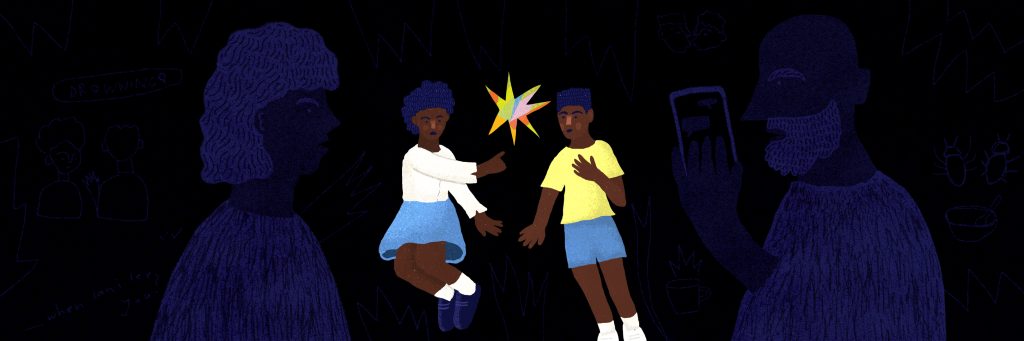
The new game Oyin and I invented is called Shock-Me-I-Shock-You. We play it whenever our parents aren't around. Often, Daddy…

The KrisFlyer miles of a dead person cannot be redeemed. The woman on the hotline said it as if she…
Sign up to receive new pieces of writing as soon as they are published as well as information on competitions, creative grants and more.