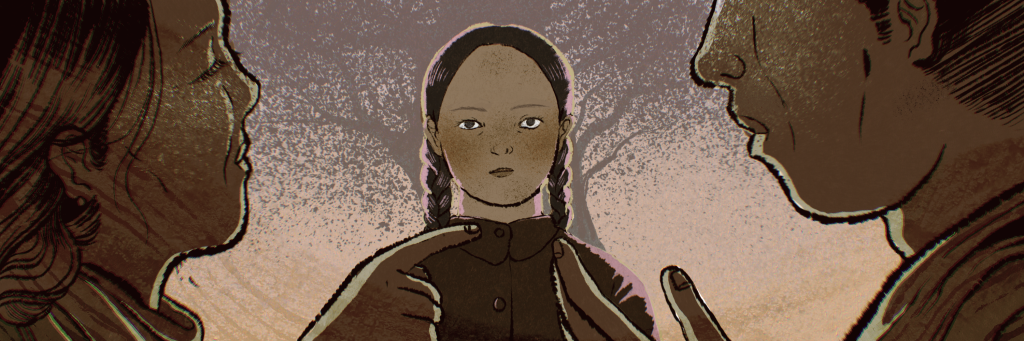
Bitter Water Village
In a rain-soaked village by a restless river, a fifteen-year-old finds her childhood collapsing under the weight of family silence…
The online magazine of new writing from around the globe
23 July 2025
Translated from French to English by Edwige Renée Dro
The dragonflies are fighting again today. They fly over my forehead, collide and crumble, wings against wings, in wild bursts of confusion. Their thin, tiny and fragmented bodies are pierced by solar waves, setting the whole atmosphere ablaze with tiny aerial sparks. I find this dance far more beautiful than that of the swans. Nothing changes: these creatures love to kill each other, to take revenge on each other; the fury of their humming has the unique property of lulling me into a vaporous madness. A rhythmic settling of scores, a shattering rampage for which I am responsible. This time, the survivor will have the right to settle on my oily skull, to devour it slowly, with no procrastination. I let it happen: the wrinkles on my face deepen; my sweat, glistening and more than abundant, penetrates the hollows of my eyes. The sun revolts, blinding me with eccentric violence, and I wet myself.
Last night my uncle died, from a heart attack or perhaps a broken heart; both options are plausible. As for my family, they forgot to tell me, or perhaps they preferred not to? It’s hard to be sure. I wake up on this shattered pavement, heated by the sun’s rays, bubbling in another pool of my corrosive piss, and this supposedly terrible news leaps down my throat. A passerby spews it in my face with putrid nonchalance: ‘Ta Raman, to tonton inn mor; desoul twa; Raman, your uncle is dead; sober up.’
We don’t use the word ‘deceased’ here; death is another one of those heavy trivialities. There’s no need for polite language or refined vocabulary, especially in this case. Nor do we say that God has taken what he gave or any such adage; otherwise the responsibility would be too great. I ask him which one, for I have several, more than enough. In that unbearable voice of his, he replies ‘the old Bugger’, and my heart speeds up, racing out of my chest, away from this conversation.
How old was this uncle? How old are the other men in my family? To what age will I live? My thoughts twist and turn, racing and spreading like a heavy, dark fog. This man missed his life, so they said. He missed the call and all the other signs that could lead to fulfilment, metamorphosis or some kind of transfiguration. He was offered the following recipe: face up to reality; extricate himself from the mires of the mind; reinvent himself just a little because life is supposedly simple; it’s hard to fail, to end up miserable. These formulas, these words sprinkled randomly over him, were, in his eyes, an impregnable quest, requiring a titanic effort at every turn.
A certain lightness of soul was hoped for him; his own soul, too cluttered, too thick, had never been able to swallow pain in small gulps. And so, drowned in an ocean of sorrow, in the middle of a tidal wave of madness, the old Bugger died one summer evening while the fans were losing their battle against untimely heat, and I was downing my penultimate glass of rum in the suffocating gloom of this godforsaken village.
The quivering of the dragonflies is still buzzing inside me; ravenous and tenacious, they swirl around my ear-sockets, keeping me away from any lucidity. The funeral is in a few hours. Grief stubbornly refuses to come; nothing in me wants to pay any last respects to this man whom, according to my failing memory, I once admired. But I get moving; I get up; I shake off my torpor. Far from being a huge area, the village is a long winding road where the houses hug each other, and the vegetation spreads out on all sides. Here, nothing happens; neutrality clings to every being; good and evil do not exist, only a passive acceptance of everything, a culture of submission to what is already in place.
Despite the way I feel and my disoriented, drunken steps, I manage to find my way to Polina’s little snack bar on the edge of the village. This refuge: its location, its rickety old foundations, its rusty tin roof and its enticing charm combine to create a true sanctuary for me. The custodian, Polina, portly, tirelessly beautiful, inordinately noisy, is one of my few childhood friends. I sometimes help with unloading her goods from the delivery lorries and close up the premises in exchange for a free meal, a half-full bottle of Seven Seas – or simply her company which has the gift of freeing me from my enforced solitude.
Without me having to ask her anything, this time she hands me some old clothes belonging to Samuel, her husband, who spends his time avoiding me but refuses to chase me out of the bar when the alcohol nails me down. These two are a bit like my parents: I impose this responsibility on them, and they accept it as best as they can, pleading with me to change, to stop drinking, but in such a way that it does not feel forced. ‘Listen, Raman, we’re sorry about your uncle; take these clothes; go and clean up, and make sure to look presentable. We’ll come before the body is cremated.’ These few words from her caress the back of my mind; they soothe me. I suddenly feel loved. I love this pity she nurtures for me; it gives me permission to live.
Linen shirt, striped flared trousers; they didn’t have the traditional white mourning kurta for me, but this uniform will have to do. I stumble a little more before reaching the village’s main river. An ineffable fluvial entity, it is known to all who live here as the tomb of many of our women, who abandoned themselves to drowning while washing their clothes in the morning. The indomitable vegetation kept them prisoners at the bottom of the river, lulling them to their final breath in a liberating asphyxiation.
For many of them, this place had been an escape from an overly violent husband, despotic in-laws or a filial curse; not anymore. These days, the women sharpen their knives and slice up their executioners. This makes me laugh. I come here mainly to listen to them; they’re the few women who still want to talk to me. Their voices resonate with every gust of wind, harmonising with the trickling water as they recount their rapes, their forced abortions, the beatings, the shame, the pain, all the suffering in the world.
I dive in, clean up. As for me, I escape drowning because they protect me and want me alive. I may have a destiny to fulfil, but they don’t expect me to avenge them; I don’t have that kind of rage. This is where I take all my baths, and I can’t remember the last time I went into a proper bathroom with a shower head, soap and wasted water. In any case, I prefer this unalterable stream, which uproots rocks from their crevices and refuses to obey anyone.
Not having a towel, I wait for the heat to dry me off so I can put on the clothes the couple gave me: two disparate shades of white that will have to settle on this ashen skin I was born with, ferociously darkened by too much exposure to the inquisitive island sun. Too skinny, too bony, without adiposity, nothing is really to my size. But the benevolent spectres of the river assure me of my elegance: I look like their sons. These words give me the necessary strength to set off towards the home of the deceased. I feign grief. I gather up all the embarrassment of my existence and transcribe it onto the drawn lines on my face: I could be an actor. I still reek of alcohol; the smell stings and dilates my eyes. I am however the proud owner of a thick head of hair, brilliantly whitened, contrasting thus with the shiny skulls of the other males in my lineage.
A large, tarred courtyard stretches out in front of me, and the colour and smell remind me of the wounds, the cuts and the scratches of my early childhood – when my cousins and I used to kick each other in the face with footballs and fists. This vast, dark, shadowy plot of land stretches out like a lake in front of the house of Dadi, my paternal grandmother. The building, always fragile, has been painted and repainted, to finally glow with a shade of amber orange and aniseed green that meld within me into a surge of powerful nausea.
The courtyard is teeming with old people. Their eyes randomly fall on me. I recognise most of them; I know their stories, their lives, everything about them, without ever having grown close to any of them. I can no longer fake the painful expression of grief which would certainly deserve an Oscar. My face breaks into an irreverent smile; I almost chuckle; my brain is giving up on me. Faced with my rictus and other awkward outbursts, the men of my lineage look away, dispersing into the crowd with discreet irritation. Pulses of annoyance and embarrassment take hold of me. Memories flood back; the past surreptitiously resurfaces; those damn flying insects are back, bringing with them humiliation and fear.
Hidden away in their huge fortresses or sitting in their big fast cars bought for a fortune, these men, my brothers and my fathers, have given themselves permission to erect a model for each of us, to underline our mistakes in red ink, to pass judgment on our lives. Hiding behind their piles of cash and a thick fog of denial, they refuse to see our common traits, to accept the disconcerting weakness that is our true heritage, the only inheritance distributed equally, like a curse. For my part, I’ve never been able to hide what I am. Nor have I ever liked money; its smell gives me hives; its colour blurs my vision. So, I soon stopped having any. The same with cars: the noise of their engines annoys me; all that black smoke coming out of the exhaust pipes horrifies me; it doesn’t bode anything good. Nonetheless, I find it hard to dislike these men; I see in them what they’ve always worked so hard to contain, what alcohol unleashes in me. They wander through my thoughts when I end up in hospital because of my excessive drinking. I think of them when I forget to pay for my bottles on the way out of the shop. I can hear their insults in the distance when piss runs down my legs, and I can’t move.
The red resin Monobloc chairs, placed in a circle around the house, welcome more and more people. The old Bugger was popular within the village; he used to be called the minister. He had it all: intelligence, blind self-confidence, burning ambition, everything, and then nothing. I finally see his body placed in the central room of the house, dressed like a maharajah from the great peninsula – although our ancestors came from Bihar, landing here with the nickname of kulis, kings of the land, master farmers, tamers of sunburnt trucks. They didn’t just sit on a throne and make decisions; they fought wars, against themselves and against others. But I tell myself that, in this final stage, he deserves his moment in the sun. I check his big toes, tied together as they should be – I learned a long time ago that this was to prevent evil spirits from penetrating through the anus, taking over his body in death and urging it to wake up.
On a small wooden table stands a photo of him as a young man. Next to it, an earthen lamp with a timid, flickering flame. Incense smoke fills the atmosphere, barely concealing the stench of rotting flesh; I feel like I’m going to puke my guts out. The uncle looks sad. He must be thinking, even in death, of the woman he loved but who never agreed to marry him – or of the thousands of other women he brought into his home to forget the first, the one who caused him the most torment, the one who amputated a piece of his soul. A crack that turned into a deep crevasse and finally gave way to a vast emptiness, a black hole that took over his life, his whole existence.
Everything I know about the old Bugger’s life, I learnt it from other people, from Dadi who told his story with fascination and nostalgia, like she was recounting a great epic romance. Before he met the woman he wanted to marry, the uncle was a man of impressive stature, with his shirt always unbuttoned to reveal a hairy chest. People went to him for advice and services.
Which university should my son go to?
Can you talk to this or that minister so they get me a job in the public sector?
Which vegetable should I grow so that I can sell it at a good price at the market?
Every village here elects, out of a certain intuition and a need for security, a man whose job it is to guide them off the beaten track, away from precipices, towards a civilisation they think is necessary, a man whose duty it is to catch them before they fall. So, the old Bugger collected encyclopaedias, drove a big, bright blue 4×4 car that intimidated others. But it’s a well-known fact that the bigger the vehicle, the more fragile the ego, the deeper the hidden desire to prove one’s manhood. This is a rule, which is why I’ve only got a bicycle; speaking of which, I can’t remember where I put it.
Yet the woman he so coveted never gave in to the grandeur he created for himself. His fine words weren’t enough to charm her; his accumulated wealth couldn’t manipulate her into marrying him and prolonging a line of broken men. This refusal marked the beginning of a long and painful inner decomposition. The uncle invented all sorts of distractions to escape his pain, throwing himself into the arms of other women, setting up and dismantling small businesses, embarking on thousands of projects that all fell through and even more relationships that all ended up going sour. No doubt he did his best.
What was it about this mystery woman that was so disarming, so intoxicating as to destroy such a giant? How irresistible could she be? I wanted to meet her, have a drink or two or four with her and then beg her to marry my uncle, ask her to love him just a little and then a little more every day, not deprive him of the life he wanted. Yet no one seems to really know what became of her. Her identity blends into and is still attached to several names: Namrata, Geeta, Riya, Devi and Amrita. It is difficult to seek her out or even to hate her properly. Even the river spirits know nothing about her. My helplessness and embarrassment end up producing tears that I hold back. Soon I’ll flood this room and drown these hypocrites with me. No, I refuse to believe this story. It wasn’t that woman who killed the old Bugger: it is all of us here. We abandoned him to his malaise, to his loneliness. He was six foot two, always a big mountain bulging in his jeans when he sat down, but he had a fragile heart. An alarm goes off inside me that I can’t turn off; I cry; I moan; I shout.
I emerge from the death chamber and sit apart from the others, on one of the chairs that will soon melt in the sun. I feel the arms of Morpheus embracing me, the only arms that still welcome me. All those sobs lull me into a soft, mellow, rare sleep. I slip into another world as I wait for the prayers to stop and for my uncle’s body to be reduced into ashes. Faces with feminine features take shape under my eyelids. It has to be said that we’ve never known how to love with temperance in this family; our love methodically shuts others in or ends up shattering us into a thousand pieces.
The oven grows impatient, and the priest leads noisy liturgies in which all the men in the family must take part. The prayers are clumsily uttered, supposedly to ensure the peaceful departure of this tormented man. One of the hymns demands that his name be said. Everyone hesitates; we had banished this name from our daily vocabulary. Over the last few months, it had been invoked a few times in hospital or in writing but rarely on our rough tongues. Over the years, the old Bugger became increasingly rare in family photos. He would disappear for days, weeks at a time, then reappear a few hours before he retreated again to his house. Very quickly, his name faded from our vocabulary. We nicknamed him the old Bugger: a spectral, ghostly appellation for a man who seemed to keep the solitude of the whole world deep in his pupils, for a man who never gave himself permission to breathe properly. Even back then, this name thing had been the beginning of our mourning, our abandonment, a way of expressing our cowardice.
I scan everyone’s faces, hoping to detect the slightest signal: the gentle frown that would invite me to join in the rituals, a friendly nod asking me to come closer and carry out this family duty. Nothing. Heads bowed, everyone busies themselves under the orders of the priest. The place reeks of despair, finitude and a kind of disappointment that the last traces of alcohol accentuate in me. How long does it take for the soul to leave a body? Thirty minutes? Two days? Has it already left the body before the heart stops beating? How can we leave in peace after an existence spent in sorrow, in the mire of secrets? Has this malaise, which we seem to share with him, perhaps already seeped into the core of our souls? So, how do we get rid of it?
Determined to assert my filial right, I weave my way, not without difficulty, between the many neighbours, acquaintances and strangers populating the concrete building where the ceremony is taking place. I wobble taking my first confident step, then a second more timid one before finally stepping in front of the crowd. The old Bugger’s inert body no longer looks like him; he’s another one of those corpses you have to force yourself to look at. I take a third step towards him, but something hits the back of my neck before bouncing off my shoulder and ending in the palm of my hand. My fingers automatically close around it, and immediately a shower of brightly coloured flowers bursts forth unannounced. I probably didn’t listen to the priest because this multicoloured cascade, these petalled sprays, magnificent as they are, mean that what’s left of the uncle is going to be thrown into the pernicious flames of the incinerator oven. I hear this one open with a shrill cry: I don’t look; I open the palm of my hand, which holds a yellow allamanda, and I raise my head to try and throw this fragile flower, wet with my sweat, at the old Bugger, to bid him farewell. But he’s no longer there.
A hideous man, bent like the hunchback of Notre-Dame, closes the incinerator with a severity that is too pronounced for my taste. ‘Stand back; disperse; it’s time to leave. It’s best not to linger here.’
Nailed to the ground, unable to move, unable to get out of my mental cage, I breathe in the atrocious smell intertwined with the last wisps of incense smoke released into the air. My brain, still a little rum-fogged, offers no guidance. Only three of the old Bugger’s four brothers are present. They are talking to the priest, trying to understand the rest of the rituals because the next few days are going to be filled with post-mortem rites and religious practices. Like a trio of warriors too involved in his death but not so in the uncle’s life – an attempt to make amends, perhaps, a last burst of benevolent pity – they nod their heads militarily as the pandit reminds them that the ashes must be collected at 5am sharp the next day, not a minute later, so that they can be scattered and followed by other prayers more commonly known as services.
Despite all the funeral chaos, I find that there is still a certain solidarity within this family. Of course, it’s out of the question to get too involved in the dramas of the living, but in death there is a semblance of friendship, a frail fraternity. I guess it’s much easier for us to maintain a certain intimacy with the dead; at least there’s no need to talk, no one to talk to. Unfortunately, our emotions will never find a crack through which to penetrate; for us, mourning will be no more than a formality lasting three or forty days, an impasse through which we will emerge without too much difficulty, without any after-effects, each in our own corner.
Too tired and too sober to make my way back to the river, which usually lulls me into my rare nights of sleep, I settle down under a tree outside the crematorium. Under a sky shrouded in flames of twilight and overflown by a fleet of mocking bats, I relax, carefree, with pleasant ease. I imagine myself as the guardian of the ashes of this uncle who has undoubtedly already forgotten all traces of my existence. I look for the last drops of alcohol in my exhausted body; it seems to me there are none left. I let myself be seduced by the idea of waking up at dawn to buy what I need to make tomorrow more bearable. Nearby, I think I hear the mooing of a herd of cows, which only produces milk. Like a cat, I fall and dig into my sleep. I turn Samuel’s white shirt, now yellowish, into a pillow. I think I detect a bit of his scent. It calms me.
The morning explodes with a creaking sound; the air has a purity that is foreign to me, and my body jolts awake. A sour, choking smell of urine finally violates my nostrils. During the night, I have pissed myself again. It’s been a long time since I had any control over this body, or maybe a dog pissed on me or even the old Bugger from beyond. The noise seems to be coming from the gate opposite, which one of my cousins is closing behind him with one hand while the other clutches an earthenware pot that must contain my uncle’s ashes. I struggle to get up from the ground; my whole being seems to have taken root in the earth. Between cracking bones and disorientating dizziness, I put my shirt back on. Slowly but surely, I make the effort to get back on my feet. I’m in no hurry because I know where they’re taking his final remnants. I’ll be able to get there before they are scattered.
The ashes of a deceased person are not destined for the ocean. The waves stubbornly refuse these human relics, invariably washing them ashore. Here’s some practical information for your future funeral rites: the sea rejects this obscure dust, as do the crabs and even the golden sands of our beaches. No marine entity is willing to welcome human remains, and the old Bugger deserves no further rejection. It is therefore to a discreet, idle, glacially serene lake that I hurry. This body of water, disconnected from the ocean, was also home to my grandfather’s ashes once upon a time.
I enter the dense forest that surrounds the lake. The sky wears a pinkish veil, a pastel shade that reminds me of candy floss. The moon still clings to the sky, full, luminous and wise but shyer at this time of day. My uncles and father have not made the trip; only their bastard sons are present to represent the lineage. No daughter has ever had a say in this tradition. According to our elders, women, suffocated by the weight of sentimentality, should not be present during these final rites. By expressing their grief too openly, they could hold back the souls, preventing them from leaving and condemning them to haunt the realms of the living. That is how, in our culture, women give life while men take on the heavy burden of funeral farewell.
In the seaweed-green water, a mixture of milk, flowers, strange seeds, a shattered coconut and a terracotta ornament scattered in fragments float symbiotically on a banana leaf. Sooner or later, this offering must sink, disappear entirely into the lake’s waters. I stand back behind the tall trees nearby, away from the rituals this time, preferring to observe rather than participate, no longer feeling the need to get involved, the alcohol no longer flowing through my veins.
As a faithful observer, I make sure that nothing goes awry. We are no strangers to blunders; they are part of our family history. One of the cousins keeps slipping on the rocks; another tries to light a cigarette, but the wind refuses. The oldest seems to be lost in a labyrinthine dream: his eyes are empty, his sadness palpable right up to my hiding place. He was the old Bugger’s most loved or best loved; in this shattered existence, in this disappearance, he surely sees a glimpse of his future.
My legs go numb; twenty minutes or so have just passed, and the troop finally crouches down outside the territory, without turning their backs on the lake so as not to disrespect the last fragments of the uncle. They neither notice nor sense my presence, yet the smell that emanates from me is fetid. Without liquor to enliven my interior, I am only half a being; I only exist by a quarter.
The sun begins to settle the pink sky, which changes hue as the moon fades. I make sure the place is truly deserted and slowly emerge from my hiding place. There’s something bubbling on the other side of the forest, a heat that jolts violently between the scattered trees. The groaning of cracked twigs gives the impression of a fire in the making. Who could have set fire to this place? I’m shaking a little; I don’t know why, but I’m not afraid. The lower part of my body grows heavy, and I kneel on the ground, unable to break free from the vegetation.
From the other side of the lake, a silhouette emerges from the forest with fiery intensity, as if just freed from a prison, breaking the chains that held it in the depths of the woods. It gradually takes shape, its stature dominating the plot of land despite it not being particularly tall. It is a woman, but her face is unfamiliar to me. Her greying hair tied up in a bun is reminiscent of a warrior. She wears a bright red kurti and loose beige trousers; she is a blazing fireball in this highly flammable landscape. What is she doing here? Why disturb this moment of intimacy that is rightfully mine? I stare at her; she doesn’t see me, doesn’t suspect the presence of a drunkard nearby.
She unties the knot holding back her hair, lets her trousers slide down her slender legs and takes off her top with a disconcerting certainty and a burning gaze. I suddenly shiver. She looks like a woman who’s lived; she bears the scars of a charged life. Now completely naked, her body radiates; she’s solar, her beauty volcanic. I blush; everything in me is confused, though I feel the beginnings of anger but no desire for her. My sex rests tenderly between my legs; it’s been a long time since I’ve had any sign from it; it doesn’t want to be a phallus anymore, just a soft extension that sprays me at every turn.
This woman is heading straight for the lake, dipping her right foot, looking into the depths of this spring, piercing it with her eyes. A tempestuous itch seizes my scalp; I don’t understand this reality. Half her body is now submerged in water. I spot an N-shaped pendant hanging from a chain around her neck. The top of my head bursts into flames; I tap, scratch, rub and dig, but the eruption doesn’t stop. Names starting with N invade the walls of my mind, spilling out on either side, but nothing lines up for me to think about the identity of this woman. She disappears to the bottom of the lake, evaporates where the banana leaf sank before she arrived. I look down at my hands; strands of hair are cluttering my palms; they must have been uprooted the moment my fingernails dug into my vertex. The dragonflies are back, swirling around me, drinking from my madness.
In a rain-soaked village by a restless river, a fifteen-year-old finds her childhood collapsing under the weight of family silence…
In an overcrowded family home governed by an unseen god, a young girl comes of age under rigid rules, until…
A Trinidadian bassist flees to Lima to escape his past, but a relentless rhythm follows him across the sea, turning…
Sign up to receive new pieces of writing as soon as they are published as well as information on competitions, creative grants and more.