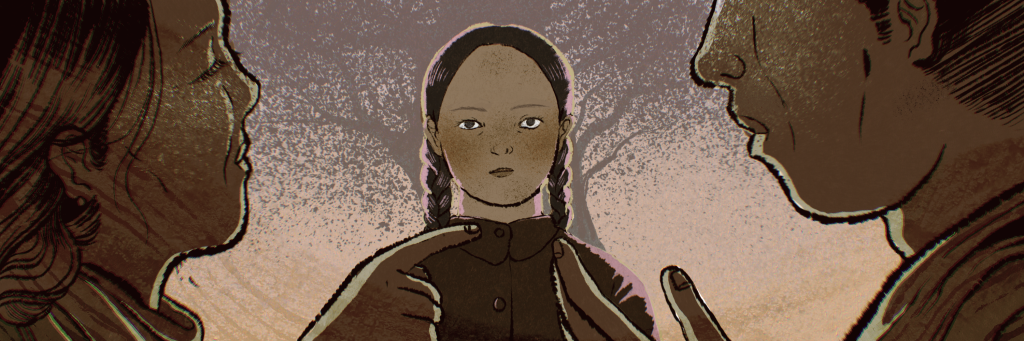
Bitter Water Village
In a rain-soaked village by a restless river, a fifteen-year-old finds her childhood collapsing under the weight of family silence…
The online magazine of new writing from around the globe
8 July 2025
August 1977, Jaffna
The year that I turned eleven, every Wednesday, when school was over, I would skip the two miles home. My fine black hair, plaited by my mother’s careful hands every morning and loosened by my impatient ones every lunchtime, would fly up and down behind me, wispy and wild. My starchy white cotton dress clung to my body in the afternoon heat. My knees were sore, scuffed and scabbed from kneeling on the concrete at lunchtime – a punishment for talking in class again. Mrs Ramachandran’s evil eyes and ears never missed a thing.
The youngest of five children and the last one in primary school, I was accustomed to making the journey home alone. As much as I longed to join the ‘big girls’ on the other side of town, I had come to enjoy this small independence: this half hour that was only mine. Today I felt especially buoyant, as it was the last Wednesday ahead of the month-long holiday. August stretched out before me, the peak of it still a salivatory fortnight away, the beginning of September a blip on the horizon.
The further I skipped away from town and the closer I got to home, the lazier the streets became: traders yelling outside busy stalls and shopfronts gave way to the gangly young man holding up a papaya to me from his bullock cart with a wink; hordes of anonymous schoolchildren became a moustachioed uncle rolling up the shutters of his tutory for evening lessons; and the grey concrete turned into red earth and yellow dust and green laneways.
Eventually, I turned off the KKS Road and passed the sleepy old men who’d congregate all evening on the verandah of the house on the corner of our lane.
‘Neema, is school over already?’
‘Darkie, what’s the rush?’
‘You know where the girl’s running to – it’s Wednesday!’
But I had no time to stop and talk. My two middle sisters, who shared a bicycle between them, would be back soon. My feet picked up momentum.
After sliding off one shoe at a time on the front verandah at home, I hurried inside, noiselessly moving across the red cement floors. The black and grey, tiger-striped bun atop my mother’s head caught my eye from the kitchen, but I ignored it, continuing to the back of the house, where I slipped outside. I made a straight shot for the gap between the mango trees that marked the boundary of our property then leapt over the woven coconut-leaf fence with practised ease, ignoring the call from behind me – ‘Neema, sweep the verandah first!’ The pleated skirt of my white dress whipped up and down before my bare feet landed.
At last, I whirled through the open double doors of the low, wide bungalow diagonally opposite my own and into the kitchen, much bigger and brighter than the one my mother was steaming puttu in that very minute. Unlike the honeyed, creamy aroma of freshly grated coconut I’d breathed in seconds ago, I could smell only faded woody sambrani in this house.
The doughy woman sat on a stool in front of me cackled as I stepped closer. ‘Never late, are you, darkie?’ I scowled at the familiar nickname; Mani, the most uninspired of my siblings, came up with it when I was two and she was five, and it had since spread through my own family to every family on the lane and now even to my classmates and teachers.
‘Has it come?’
Santha Maami nodded at the gleaming box in the middle of the green-painted room. ‘Here—’ She turned to reach behind her with difficulty, then handed me a chipped pink plate with two slices of bread and a small spoon on it. ‘Go on, take a little, but leave enough for us, hey!’ Another cackle.
I opened the much-coveted refrigerator – the first one I’d ever seen in my life – and my mouth filled with saliva as soon as I spotted the slab of butter. I spooned off double the amount that Santha Maami would have approved, but the refrigerator door shielded my gluttony from her.
Holding the plate behind my back with both hands, I turned to bestow on my maami a sweet, sweet smile: ‘Do you have any sugar?’
And then I spent the most delicious five minutes of my week sat beneath the shade of our mango trees, industriously churning half a teaspoon of sugar into the scoop of butter at the side of the plate, my tongue barely poking out between my lips. I dipped the bread, chunk by chunk, into the saccharine butter and ate it.
Halfway through my meal, my sisters, Anju Akka and Mani Akka, finally arrived home.
‘Look at the little scavenger!’
‘Neema, you must stop this; it’s shameful. Maami already thinks we don’t eat well.’
‘How much did you take?’
‘Just another reason for them to turn their noses up at us.’
Anju Akka stuck a finger into the remaining butter and licked it. ‘Funny, that butter is as sweet as you are sour—’ she grabbed my wrist and held it next to hers ‘—and as fair as you are dark!’
Only my sisters could get away with such insults without receiving a sharp slap in return, but that didn’t mean I liked it.
‘I saw you yesterday with that boy again!’ I tattled. ‘You didn’t see me, did you?’ Anju Akka’s nostrils flared, but I was too full of vicious glee to heed the warning. ‘What were you doing with him? Amma will kill you when I tell her. And if Appa hears—’
She pinched the miserable brown flesh of my forearm, and I squealed, unable to retaliate as I was still gripping my plate with my free arm.
‘Shut your mouth, or I’ll throw you down the well.’
I scrunched my eyes closed and screamed out: ‘Amma! Ammaaaaa! I have to tell you something! Amma!’ With each yell, the fingers clutching my arm twisted harder.
If our eldest sister, Prema Akka, had been there, she would have defused the situation expertly: kind words to soothe my hurt feelings, wise counsel to appease Anju Akka’s distrust, all while shepherding us back indoors. But she had moved to the hill country a year ago to retake her A-levels. Prema Akka now lived in a hostel in Passara with other girls her age and no parents or older siblings to plague them.
Conversely, if Sivam Anna had been there, he would have turned his back and gone inside alone, shaking his head at the misfortune of inheriting foolish sisters like us. But he’d been in Colombo for the last fortnight, staying with a distant cousin while he tried to secure job interviews. More than a decade older than me, Sivam Anna held the double distinction of being my only brother and my eldest sibling. I adored him from afar, but up close he treated me like a mosquito, a pest to be swatted away if I got too close. He’d shaved his moustache off a month ago, and this only made him more unapproachable to me, a stranger’s face atop my brother’s stocky body. He said he’d done it to look ‘decent and professional’ in interviews, which I didn’t understand – I loved twirling the ends of Appa’s moustache while he napped.
Suddenly, something soft and scratchy whacked me over the top of the head. I dropped my plate of bread and butter at the same moment that Anju Akka dropped my arm. The bristles of a broom head. The broom came down again and again on me and Anju Akka in turn, only Mani Akka escaping our mother’s wrath, as she always did.
‘Girls, get inside! The neighbours will think fishwives have moved in. Anju, it’ll be you down the well if you don’t go inside now.’ Amma turned to me as I ducked the broom and ran for the house. ‘Neema! Next time I catch you begging for food when you should be sweeping, you’ll be running from Appa and his belt.’
An empty threat.
I skipped through the house and back out the front, planning to find Radhika’s bike and steal it for a few hours.
*
The first day of the school holidays, I accidentally woke early, earlier than I ever had to for school, earlier than everyone in the house but my mother. She had no doubt already left for Thirunelveli market to sell our meagre crop of okra and moringa.
We had one bed in our house, and us three girls shared it in our small back room. Amma and Appa slept on a pai in the front room. A year or so ago, they’d stopped leaving the door to the verandah open overnight, even on the most sweltering evenings.
My assigned position was at the edge of the bed, nearest the shuttered window. I rolled over and dropped my feet to the floor before shuffling out of the room. Making my way around my sleeping father, I went outside and greeted a neighbour’s goat, who’d wandered in through the open gate.
It was still cool outside, and a breeze tickled the hem of my nightie, which was too short on me, hitting only mid-shin. I knew I’d get in trouble if anyone saw me in public without a housecoat on, but I looked ridiculous wearing one, my skinny limbs shamefully swamped by the material.
I shrieked as something nipped at my ankle, and the goat galloped away in fright.
‘Hey, no! Doggy, shoo! Go!’ A bullish terrier, white all over with a black patch around its left eye, weaved between my hopping legs. I’d seen it before, terrorising chickens and cows and women sweeping their gardens. I always ran past it quickly; I wasn’t afraid of dogs, not the ones I knew anyway, but there was something brutish about this one. It was scrawny and behaved like it didn’t belong to any particular household, stealing scraps and drinking from troughs, but it didn’t run away from loud noises or violent kicks like the other strays. Instead, it would stand its ground, like a boxing champion with four top-heavy legs.
Now, it faked one way then the other, baring its teeth at each of my ankles in turn, occasionally making contact then pulling back. I was convinced it would tear off a chunk of my flesh any minute, but when I closed my eyes and fell to the ground in surrender, I felt a wet lick up and down my shin. On opening my eyes, I was met with another lick, this time on my nose. I laughed in surprise then, unable to bear the sudden release of tension, burst out crying. My gasping sobs brought my father outside to a misleading vignette: me, crouched low, holding my shins and in tears; the dog, trying to burrow between my knees.
‘I was asleep, Neema!’ He yanked the dog by its neck and strode out to the lane.
‘Appa, no! He wasn’t hurting me!’ I stumbled to a standing position and ran after him.
‘The little bastard killed one of Santha’s chickens last week.’
‘Where are you going? Let him go!’ I’d caught up with my father, but he held the squirming dog high above me, out of reach of even my highest jump. ‘I’ll teach him; let me try.’ I tried running backwards in front of Appa; I didn’t know where he was taking the dog, but I could tell he was in one of his moods.
‘You woke me up with your screaming to tell me this? Get out of my way!’ And with that, he took a sharp left down the alley that led to the communal well. This was where we came to collect water for cooking or to take our bucket baths behind a sheet of rusty corrugated iron that we’d position for privacy. There was no one there now, the metal sheet leaning against the well for the next early riser. But I knew Appa wasn’t about to give the dog a bath.
I stopped in my tracks and turned back around. I couldn’t watch but I couldn’t leave. A few moments later, I heard a whimper and then a muted splash.
Appa was back by my side in seconds, his arm loosely wrapped around my shoulders as he led me back along the lane to our house.
*
We reached the peak of the holidays all too quickly. The midpoint I’d anticipated so joyously at the beginning of the month was anti-climactic now it was finally here. I’d been tricked by time.
I spent the morning tormenting my sisters, hiding their magazines, sneaking up on them when they huddled in corners to gossip without me. Sivam Anna was due back home today, having caught the early train from Colombo in darkness hours ago. It would be crossing the narrow Elephant Pass causeway now, passing square salt pans and flat rice paddies, bright pink flamingos and dull grey gulls.
As we approached that nebulous overlap of late afternoon and early evening, we all settled around the front verandah: Mani Akka perched on the step reading a magazine poorly concealed inside the pages of a school textbook balanced between her knees; Anju Akka lay flat on her back on the swinging wooden chair, her eyes closed; and I stretched out on my front on a prickly pai just inside the doorway, avoiding the low sun which still coloured the sky in pale pink and orange stripes,
Sivam Anna hadn’t yet arrived, but we weren’t worried. The train was often held up, sometimes stalling at Jaffna station for half an hour or more, before it carried on to the local stations like Kokuvil, which was where my brother would disembark.
Amma came out to take down the clothes drying on the line, hanging them over her arm. This was the only time of day she was ever close to still; under the pretence of collecting clean washing or sweeping the same patch of earth, she’d wait outside for an age to see if Appa would return home from work at a respectable time. She’d watch the rusted, yellowing gate, which remained open until dark.
Appa was a local government clerk. I didn’t know much about his work other than he got moved around the country every few years, whenever he fell out with a colleague (usually his boss); in the last decade, we’d lived in Mannar, Badulla and Anuradhapura. Three years ago, we returned permanently to Kokuvil, Amma’s ancestral village, and moved into the house she was born in.
If he hadn’t made it home by six o’clock, we knew Appa likely wouldn’t come back until the small hours. On those nights, sometimes he’d swagger home and hang off the closed gate with both hands clutching the post, singing off-key for one of his daughters to come and let him in. Other times he’d try to sneak inside quietly, either climbing over the gate and falling into a limbless heap when he reached the verandah step or completing my butter mission in reverse, stumbling through his sister Santha Maami’s house and creeping back into ours under the cover of our mango trees.
But what would happen most frequently was that a neighbour would call by our house after dinner to let us know that our father was in the middle of a drunken fight with one of his brothers-in-law or a colleague or occasionally a stranger, and I’d be dispatched to collect him. It was always me. Anju Akka was too beautiful to send out into the night to tackle grown men; even I recognised that. Mani Akka could barely make herself heard in our family of seven, let alone in the middle of a ruckus between grown men. Sivam Anna would have died of shame sooner than associate himself with our inebriated father in public. And troublesome things like this just didn’t happen when Prema Akka was at home.
So, I would be sent out, the youngest child whom Appa couldn’t refuse, to wheedle, cajole and mollify, all in preparation for my one and only party trick. I’d circle behind him, head low in defeat, then leap onto his back like a monkey and hang from his neck, clinging on as he tried to throw me off.
Eventually, laughter would overcome him, gradually spreading to any onlookers and even the man he’d been wrestling only moments before. Appa would give his opponent a gentle cuff around the ears, perhaps a begrudging nod. Then, he’d turn and walk home, carrying me the whole way, both of us wearing intermittent grins, his intoxicated and mine triumphant.
However, Appa was under strict instruction this week to head directly home from work. I’d overheard Amma telling Anju Akka two nights ago that the army were arresting people who were out late at night. But I already knew to be wary of these leering men in khakis who couldn’t speak Tamil, convincing me further of their stupidity.
Amma had only pulled two housecoats off the line when I spotted movement in the gaps between the drooping leaves of the banana trees. A flash of blue shirt, the downward swing of a black satchel, and then he was running through our gate. Appa was home early.
None of us had heard anything. We didn’t have a telephone or a TV back then; Santha Maami owned a radio set, but it had been left to gather dust at the bottom of her alumari ever since her sons had left for India.
Yet before Appa had taken a breath, Amma said, ‘Sivam.’
‘They’re killing people. They’ve killed people. Everywhere.’
Amma clutched the almost-dry housecoats hanging off her arm close to her chest. ‘Where’s Sivam?’
‘The trains from Colombo – they got stopped at Anuradhapura. They’re saying there were mobs of them, police and civilians; they stopped every train to search them. They tortured every Tamil passenger they could find. Bastards!’ Appa spat on the ground, leaving a dark, viscous stain where I’d swept only an hour ago.
‘No, he was on the early train; he would have reached Kokuvil soon after lunchtime.’ As Amma shook her head, us three girls stood up around her, a small army of women.
At this, Appa cast his eyes to the ground he’d spat at. ‘It happened this morning. I only heard this afternoon; I – I wasn’t there when the news arrived.’ A prolific gambler, Appa would often play truant with his youngest, most impressionable colleagues in search of his next win. ‘I’ve been trying to find out more.’
‘So why are you here? Go and find him. Maybe he wasn’t on the train; maybe Sivam never got on; what if he came up yesterday to see Sugi without telling us?’ Sugi was the girl Sivam Anna was going to marry, a love marriage that would attract even more disparagement from our extended family. She lived in the sticks, something I mocked mercilessly. If I hadn’t recognised the terror of this situation by now, this comment would have made it clear – Amma had never referred to Sivam Anna’s relationship so explicitly.
‘Yaso, that’s what I’m saying. It’s happening everywhere. Colombo, Nuwara Eliya, Anuradhapura – they’re attacking anyone they can find.’
‘It’s this election business.’ The bodiless voice came from behind Appa. ‘The Sinhalese blame us. They’ll kill us all.’ Brut Mama stepped into view across the lane. I saw other neighbours coming out, leaning over walls, walking over to our gate, talking among themselves and at Amma and Appa. I caught snatches of conversation, some of it incomprehensible to me, some of it frightening.
Santha Maami appeared as if by magic from behind us, a hand on Amma’s shoulder. ‘He’s a sensible boy, Yaso; he’ll hide somewhere until he can come home.’ I was distracted by the absurd mental picture of Santha Maami, in her ratty violet housecoat, leapfrogging the fence between our houses. Anyway, I didn’t need her reassurance; no one would hurt my big brother.
I looked around at the growing gathering. Mani Akka was weeping at Amma’s side, though it never took much to get her crying; she was the softest of us all. I only had to glare at her from behind Amma’s back to win a mango stone straight out of her hands. I glared at her now.
But it was hard to stay defiant for long beneath the threatening darkness. An hour passed without action, and I leaned against Amma and Mani Akka in turn. My eyelids flickered against my will, lulled by the low buzz of conversation.
Then we all heard someone running. Heads snapped in the direction of Bata slippers slapping the earth hard, rubber soles hitting the runner’s feet in an almost-instant echo. Rasa Anna, my cousin who lived at the other end of the lane, burst into the small crowd, silencing the chatter.
‘The train’s just passed Kilinochchi; it’s on its way into Jaffna.’
‘Empty?’ Appa barked the word.
‘No—’
‘Aiyo, he’s back; he’s back. Appa, go!’ Amma’s voice sounded as though it had been mangled by her coconut scraper. ‘Go and meet him at Jaffna station’, she rasped when nobody moved. ‘We can’t wait for the train to reach Kokuvil.’
‘Maami—’ Rasa Anna was visibly startled, and he looked to my father, then his own father, Kannan Mama. I recognised that there had been some critical misunderstanding. ‘I don’t – some of the compartments – I don’t know. They’re sending the bodies back on the train.’
*
The story of that night would be one I’d recount decades later to explain how it was back then: the way fear would drop on us without warning like a heavy blanket, leaving uneasy threads behind when it lifted away; the slow confiscation of innocence from children.
We girls and Amma waited for hours at home, too frightened to eat anything. Appa had left for the station with Brut Mama and Kannan Mama, the three of them taking up the width of the lane as they walked into the night. Appa was the only one wearing trousers, the other two men still dressed in their vettis.
We sat on the pai in the front room, a single lamp lit and flickering by the entryway. Amma and my sisters were much better than me at being still and quiet. The third time I slapped my ankle, only just missing the mosquito I’d targeted, Anju Akka snarled at me: ‘Go to bed.’
‘Leave her alone; we’re all worried’, said Mani Akka.
And Amma remained motionless, cross-legged.
By the time the men returned, I was the only one who had fallen asleep. The sound of the gate woke me up, and I rubbed my eyes open in shame, realising everyone else was standing by the doorway.
I pushed in between Amma and Mani Akka, and I saw my brother, dishevelled but smart in his suit, walking between Appa and Brut Mama.
Mani Akka was already crying, and Anju Akka had paled, but I was jubilant. I’d known all along he’d be fine. I ran forward to meet them, looping my arms around Sivam Anna’s hips, then my father’s, dancing around them.
‘Neema, go to bed. They’re tired.’ But Amma’s stern voice couldn’t douse my delight.
‘I’m too happy; I can’t sleep!’
‘What’s there to be happy about?’ sobbed Mani Akka.
‘She’s too young to understand’, said Anju Akka.
My joy was fast dissipating. ‘I understand better than you – I knew he’d come back; you all thought he was DEAD!’
‘Shut your mouth and get to bed!’
‘What kind of talk is that?’
‘Don’t say things like that!’
The cries assaulted me from all sides.
‘I’m going inside; you’re all making a spectacle.’ Sivam Anna had had enough. He made his way to the kitchen passage, where he slept on a pai whenever he was home.
‘Wait! What happened, how did you escape? Was it as bad as they said? Did they kill everyone?’ Mani Akka followed him closely, Anju Akka and I a few steps behind. Amma and Appa stayed outside with Brut Mama, their murmurs blending in with the buzzing cicadas.
Sivam Anna shrugged, typically understated. ‘They didn’t kill everyone. I’m here, aren’t I.’
‘Were you frightened?’
‘A little. Mostly after I’d got away.’
‘How did you get away?’ Anju Akka asked as we settled on the ground, watching him hang his jacket and shirt up neatly on the hook above his pai. That suit was Sivam Anna’s pride and joy; Amma had sold her only set of gold bangles to pay for it when he’d told her he wouldn’t get a job without one. It was ash-grey, with delicate yellow threads running through it if you looked closely. It seemed the entire night had passed by the time he’d straightened, folded and re-buttoned each cuff.
‘I heard the commotion – in the other compartments nearby. People were screaming. Sounds of things smashing. There were crowds of men, on the platform, stripping old men naked and setting them alight—’
I realised the gasp that had interrupted him was mine. Sivam Anna scowled at me then continued. He told us the train was full up until Anuradhapura, which we knew was where all the Sinhalese people get off the train. The Tamil passengers quickly worked out that they had to get off too.
‘But these men – I think it was all men, dozens of them. They made their way through each compartment, stopping everyone. Some passengers, it was obvious they were Tamil – giveaways like your pottus, you know, or those estate Tamils, you’d know them anywhere, right? They beat them.’
As Sivam Anna talked, he walked a little way away from us, deftly knotted his saaram over his trousers, then pulled his trousers off too, folding them over the suit hanger with care. ‘Everyone else, they asked them to say something in Sinhalese. Most people didn’t understand – they beat them too. Even people like me, who can speak a little, they can tell from our pronunciation, can’t they? Thank God, I was in the last compartment, so I had some time. I walked off with my briefcase, before they made it in.’
‘But what about the men on the platform? They didn’t see you?’
‘Not at first. I walked away from them, away from the station. I thought maybe I could just hop down at the end the platform and walk down the tracks. But then one of them caught my eye, a youngish guy, maybe my age. He looked right at me, and I thought it was all over. He spoke to me in Sinhalese; he said, “Where are you going? Come and help us finish off these Tamils!”’
It took a moment for this to sink in.
‘He thought you were one of them? But you don’t look Sinhalese at all!’ I was sure I could tell a Tamil man and a Sinhala man apart from a mile away. Was it possible the Sinhalese couldn’t?
‘I didn’t want to risk saying anything. So, I just pointed to my briefcase and nodded at the waiting room, as if I wanted to put my things away first.’
‘It must have been your moustache’, I said. They all looked at me. ‘If you hadn’t shaved it off, they’d have known you were Tamil.’ I felt grateful he hadn’t listened to my opinion on the subject.
He carried on as if I hadn’t spoken. The station master had let Sivam Anna into the waiting room, locking the door behind him. The room was full of Tamils who’d made it off the train. The station master couldn’t speak Tamil, of course, nor could he do much besides keep them all locked in there until it all died down. ‘Which it did, hours later, and then they got us back on the train – and here I am.’
We sat in silence, considering everything he’d said, the odds of him surviving this near brush with death, the evil eye we’d need to ward off.
Amma’s shadow loomed over us, twice as tall as her. ‘Get to bed, everyone. Let him rest; you can catch up tomorrow.’
‘I’m leaving in the morning, Amma.’ My sisters looked back at Sivam Anna when he said this, but my gaze remained on Amma’s face, which had fallen a fraction, barely enough for me to notice.
‘You only just got back.’ Her voice softened for her only son. ‘Can’t you stay until the afternoon? I haven’t fed you; I need to go to the market.’
‘Amma. I have people to see.’
‘People’, I snorted. Amma’s hurt had hardened me against Sivam Anna.
No one said anything more. We all got ready to go to sleep, us girls getting into bed together. I waited for either of my sisters to comment on Sivam Anna’s disloyalty, but their heavy breaths told me they were asleep. I tried to sleep too, but it wouldn’t come.
As the first embers of dawn poked through the shutters, I heard Amma moving around, then leaving for the market. I rolled out of bed and padded to the kitchen passage, where Sivam Anna was still fast asleep. Standing on tiptoes, I expertly manoeuvred his suit and hanger off the hook above him without a sound.
The front doors stood open, letting in the clay-pink sunrise – no hardship to Appa, who snored away in the corner of the room, facing the wall, one leg thrown over the other.
I went outside, holding the hanger high above me by its hook, so only Sivam Anna’s trousers skimmed the earth below. I’d forgotten my housecoat again, but I couldn’t turn back now. I walked as fast as I could down the lane, heading straight for the well.
In a rain-soaked village by a restless river, a fifteen-year-old finds her childhood collapsing under the weight of family silence…
In an overcrowded family home governed by an unseen god, a young girl comes of age under rigid rules, until…

A Trinidadian bassist flees to Lima to escape his past, but a relentless rhythm follows him across the sea, turning…
Sign up to receive new pieces of writing as soon as they are published as well as information on competitions, creative grants and more.